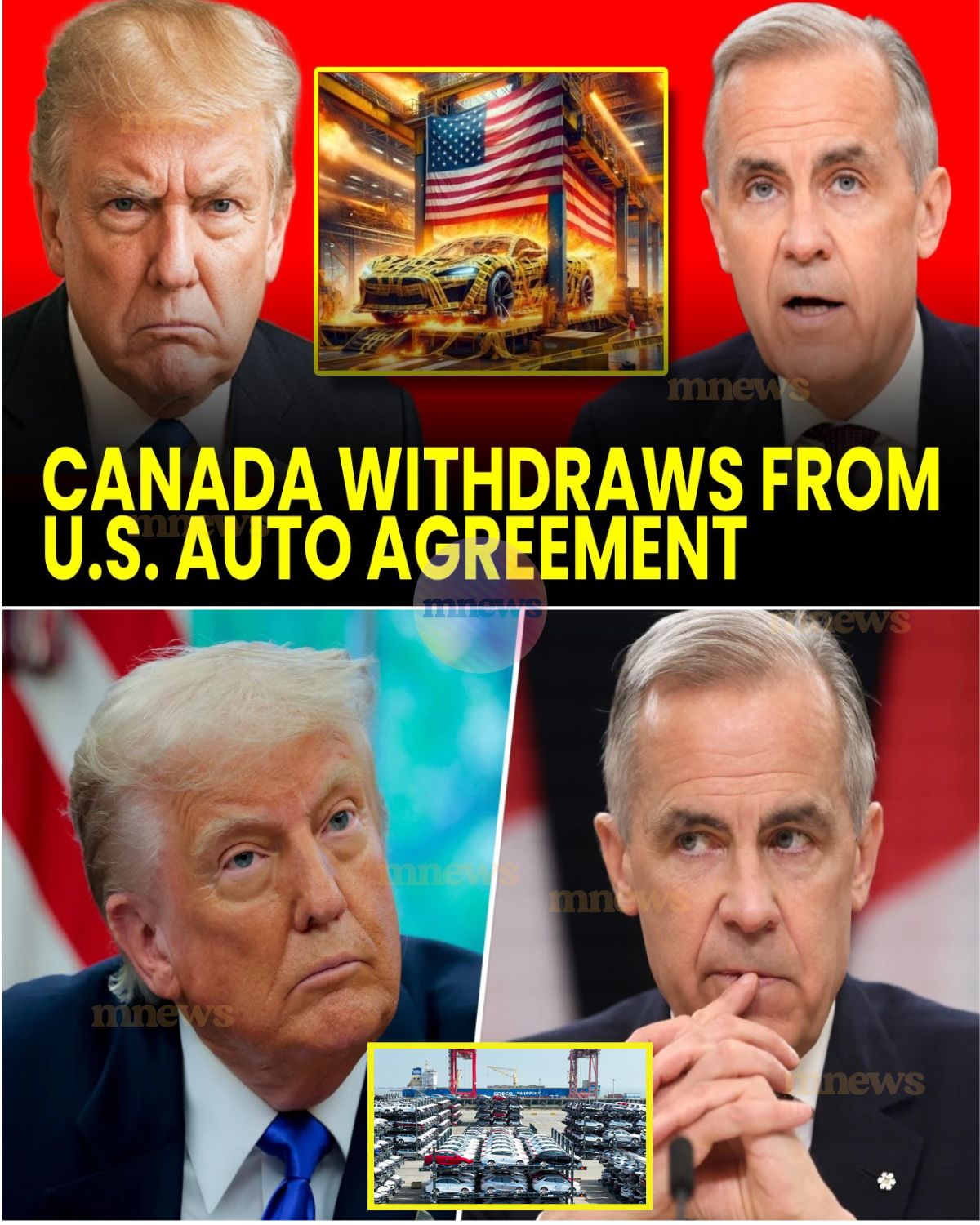
A seismic rupture in North American trade has plunged the U.S. auto industry into immediate crisis, triggered not by a new tariff but by Canada’s definitive decision to walk away from decades of economic integration.
 The Canadian government has begun formally suspending key cooperative auto frameworks with the United States, shifting from automatic alignment to deliberate strategic independence. This move follows months of escalating U.S. tariffs that targeted the integrated supply chain.
“The government of Canada will be responding with 25% tariffs on all vehicles imported from the United States,” officials announced, matching Washington’s earlier duty on foreign-made cars. The retaliation, however, is now the least of Washington’s concerns.
Ottawa’s suspension of sector agreements marks a clean, confident break from a system Washington long took for granted. The underlying assumption of predictable, fair rules has been shattered by the Trump administration’s tariff regime.

For decades, the auto sector operated as a single organism across the border. An SUV assembled in Michigan routinely contained Canadian engines and electronics. That deep integration rested entirely on mutual trust and stable rules.
President Trump’s revived “America First” agenda rewrote those rules overnight. A 25% tariff on auto imports, framed as a shield against China, landed first and hardest on Canada, treating Canadian components as a foreign risk.
U.S. analysts labeled the policy “economic friendly fire.” The immediate fallout saw Stellantis halt Ontario production, shifting thousands of jobs to Illinois. General Motors began scaling down its Canadian operations amid erratic U.S. policy signals.

Canada’s initial counter-tariffs included temporary exemptions for major automakers, contingent on concrete investment promises in Canada. This summer, Ottawa stopped absorbing blows and began actively rewriting the playbook.
It cut back tariff-free quotas for American automakers and launched formal complaints over plant closures. Every future trade privilege was explicitly linked to verifiable domestic investment on Canadian soil.
This week’s action transcends bargaining. Canada is deploying a wholly new industrial strategy built on security, independence, and reliability. The old mental map of North America has been discarded by Ottawa.
The structural shift ignited a parallel battle in public opinion. An anti-tariff ad funded by Ontario went viral on U.S. networks, prompting President Trump to levy an additional 10% punitive tariff.
Ontario Premier Doug Ford refused to apologize, instead speaking directly to American viewers. “I will fight like I’ve never fought before,” he declared, arguing U.S. tariffs on Canada are effectively taxes on American consumers.

Ford’s campaign, borrowing Reagan-era warnings on protectionism, turned a provincial ad into a referendum on Trump’s economic logic. The backlash inside the United States quickly moved from political to acutely economic.
The U.S. Chamber of Commerce warned new duties would strangle factories in Michigan and Ohio that depend on cross-border supply chains. Studies confirm tariffs add hundreds of dollars to each American-built vehicle’s cost.
Canada’s leverage stems from profound economic intertwining. Roughly $2 billion in goods crosses the border daily, including engines, steel, and critical minerals that keep Detroit’s assembly lines moving.
Any modest disruption in these flows causes immediate American price spikes and production delays. The integrated economy itself amplifies Ottawa’s decisive move without the need for overt threats.
Industry Minister Mélanie Joly has emerged as the architect of Canada’s long-game strategy. Returning from Washington, she framed the response not as endless retaliation, but as national economic reconstruction.

Joly’s three-part plan involves shielding domestic industries through government procurement, building new capacity in defense and clean energy, and leveraging critical mineral wealth to anchor global EV supply chains.
Early data suggests the pivot is gaining traction. Canadian wage growth is ticking upward, with tens of thousands of jobs created recently, fueled by rising domestic investment rather than export surges.
South of the border, the picture is one of gathering disruption. Midwestern manufacturers are grappling with higher input costs and shipment delays, squeezing margins and threatening competitiveness.
What began as a tariff shock has catalyzed an industrial awakening in Canada. Faced with a neighbor willing to weaponize trade, Ottawa discovered untapped leverage and strategic options.
The crisis now facing the U.S. auto industry is one of its own making. The question is no longer whether Canada can adapt, but whether the United States can accept a partner that negotiates as an equal.
Canada is not asking for permission. It is choosing a new path on its own terms, and the tremors are just beginning to ripple through factories and boardrooms across the American heartland.