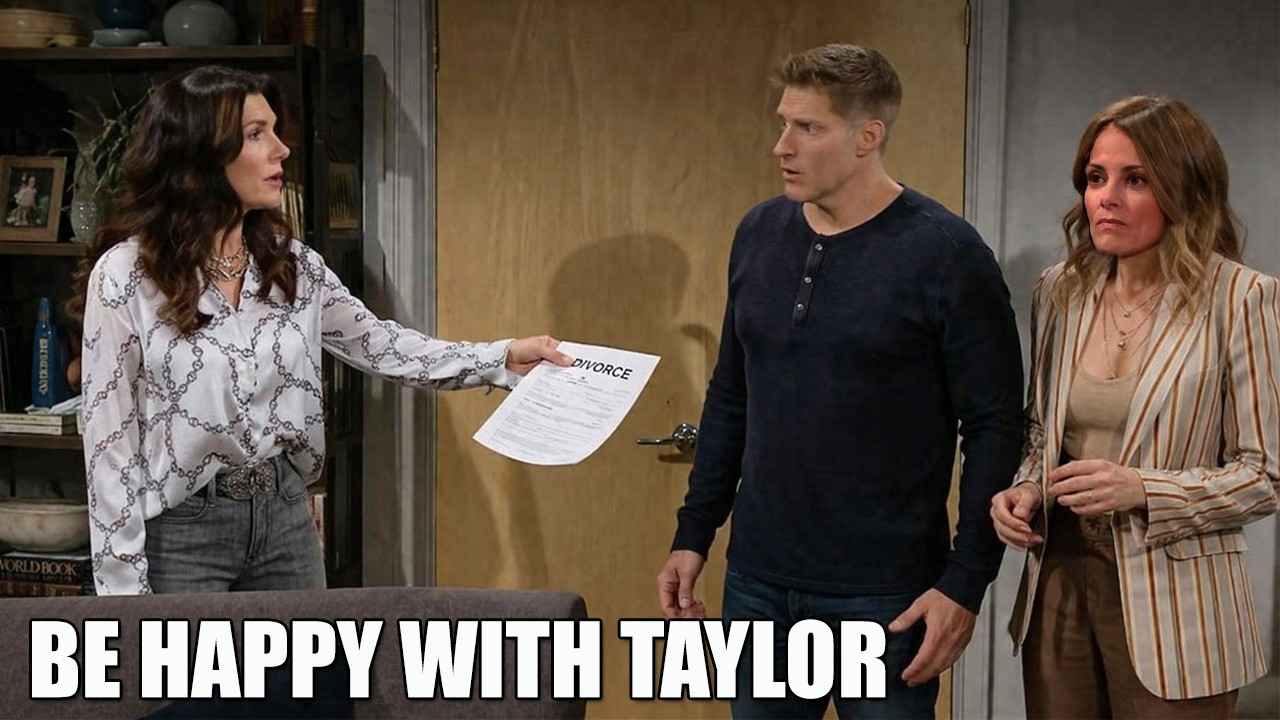
In a stunning reversal of character that has left the fictional world of Los Angeles reeling, Sheila Carter has voluntarily dissolved her marriage to Deacon Sharpe, explicitly blessing his new relationship with Taylor Hayes. The moment, long dreaded by those familiar with Sheila’s volatile and obsessive history, unfolded not with explosive fury but with a chilling, composed tranquility that has sparked profound alarm and suspicion across the city. Eyewitnesses to the encounter describe a scene of unnerving quiet, where the expected tempest gave way to a calm so absolute it felt more threatening than any overt act of violence could have been.
Sources close to the situation confirm that Deacon and Taylor had braced for a catastrophic confrontation upon Sheila’s discovery of their burgeoning romance. Given her documented history of kidnapping, manipulation, and violent retaliation against perceived romantic rivals, the anticipation of a dangerous eruption was a logical conclusion. Instead, Sheila presented an almost alien demeanor of acceptance, offering not threats but freedom. Her decision to proactively file for divorce and verbally sanction the union defies every established pattern of her behavior.

The content of her statement is perhaps the most shocking element. “I want you to be happy,” she reportedly told the stunned couple, adding that she no longer wished to cling to something that was not truly hers. This apparent abdication of claim over Deacon represents a seismic shift in her psychological profile. For a woman whose identity has been fundamentally intertwined with possession and desperate attachment, this act of release is unprecedented and, to many, utterly incomprehensible.
This dramatic departure from form has ignited a fierce debate among those analyzing the event. One school of thought cautiously posits that this could signify genuine, hard-won personal growth. Perhaps, they argue, Sheila has finally reached a point of self-awareness, choosing a path of peace to break the relentless cycle of chaos and destruction that has defined her life. This narrative suggests a potential redemption arc, a character choosing to walk away from the battlefield of her own making.
However, a more prevalent and urgent theory warns that this calm is merely the eye of the hurricane. Veteran observers of Sheila’s machinations note that her most dangerous iterations have often been her most patient and calculated. The absence of rage does not equate to the absence of motive. This new, controlled Sheila could be far more perilous than her impulsive predecessor, strategically retreating to plan a retaliation so subtle and devastating that no one will see it coming until it is too late.
The reactions from Deacon and Taylor were reportedly of pure, unadulterated shock, quickly morphing into deep-seated unease. Trusting Sheila’s benevolence is a psychological leap neither is prepared to make, given the scars she has inflicted upon both their lives. Their immediate relief is undoubtedly tempered by a paralyzing doubt, wondering not if, but when and how the other shoe will drop. This pervasive uncertainty now casts a long shadow over their new relationship.
Psychologists consulted for commentary suggest such a radical behavioral shift in a personality as entrenched as Sheila’s is extraordinarily rare without a significant catalyzing event. Whether that event is genuine therapeutic breakthrough or the genesis of a more sophisticated, long-game strategy remains the critical unknown. The transformation appears too complete, too convenient, raising legitimate questions about performative artifice designed to lull her targets into a false sense of security.
The implications for the wider social circle are immense. Brooke Logan, Ridge Forrester, and Steffy Forrester, all past victims of Sheila’s wrath, are likely viewing this development with maximum vigilance. A volatile Sheila is a known quantity; a serene, strategic Sheila represents an unpredictable and potentially greater threat. Her actions have effectively destabilized the entire community, replacing a clear enemy with an enigmatic phantom.
Furthermore, this move strategically isolates Deacon and Taylor. By positioning herself as the gracious victim who stepped aside for their happiness, Sheila morally obligates them and paints any future accusations from them as paranoia or ingratitude. It is a masterstroke of psychological warfare, disarming her opponents by fulfilling their deepest wish in a manner they cannot safely accept. The gift, in this case, is profoundly suspect.
As legal proceedings for the divorce begin, all eyes will be on Sheila’s next movements. Does she seek distance, perhaps leaving Los Angeles? Or does she remain nearby, a quiet observer to the life she has ostensibly granted to Deacon and Taylor? Her geographical choices will provide the first major clue to her true intentions. Any attempt to maintain proximity will be viewed as highly suspect.

The central question now haunting every character and viewer alike is one of profound duality: Is this the final, surprising chapter of Sheila Carter’s legacy of obsession, a story ending with an unexpected grace note? Or is it merely a new, more frightening prologue? Has the wildfire simply learned to burn cold? The absence of an immediate threat has, paradoxically, created an atmosphere of heightened tension and anticipation unlike any before.
This narrative turn forces a re-evaluation of everything known about Sheila Carter. It challenges the core assumption that she is incapable of change, while simultaneously warning that her capacity for deception may have evolved into its most potent form yet. The community must now navigate a landscape where the greatest danger may not be a knife in the dark, but a smile in the daylight.
In the coming days, every action, every word, and every silence from Sheila will be scrutinized for hidden meaning. The burden of proof lies entirely with her to demonstrate this change is authentic, a burden history suggests she is ill-equipped to bear. For now, Los Angeles holds its collective breath, waiting to see if peace has truly dawned or if this is merely the deceptive calm before a storm of unprecedented sophistication and ruin. The game has not ended; it has simply changed its rules, and Sheila Carter may have just rewritten them all.