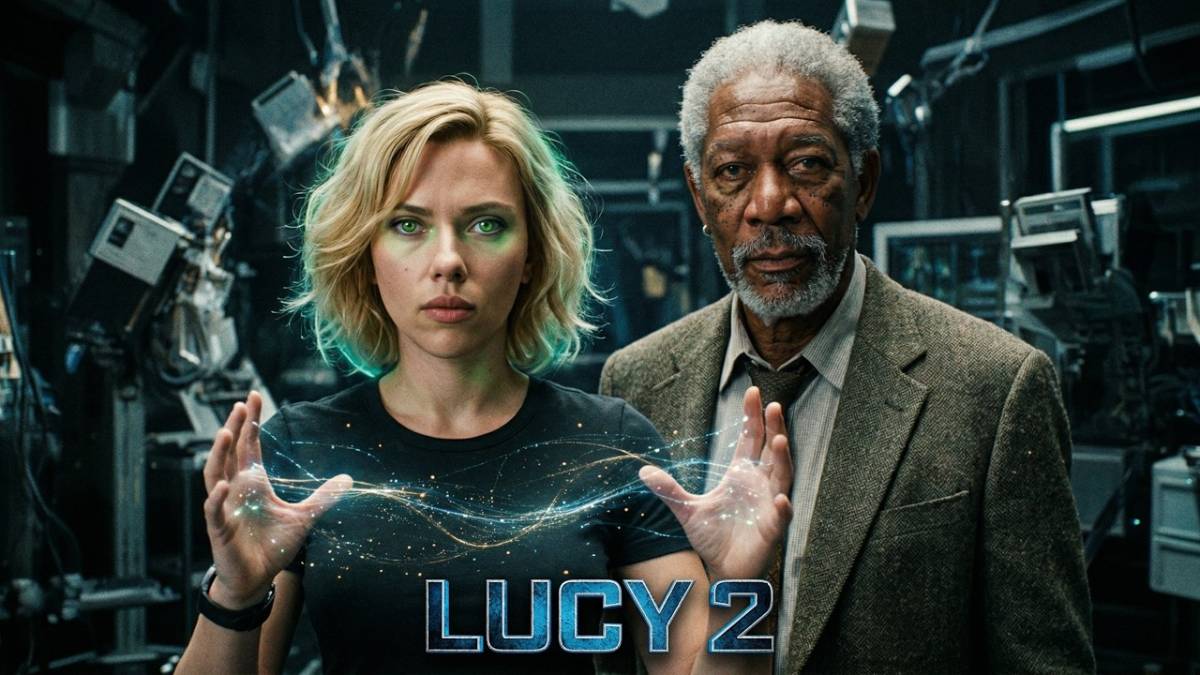
A decade after a scientist unlocked the full potential of the human mind and vanished into the cosmos, the path to her cinematic return remains one of Hollywood’s most perplexing and lucrative mysteries. The staggering financial success of Luc Besson’s 2014 sci-fi thriller Lucy, which earned $469 million globally, has long demanded a follow-up, yet its own narrative conclusion has erected a seemingly insurmountable creative barrier. For over ten years, director Luc Besson has openly wrestled with the sequel’s central paradox, a challenge that has kept Lucy 2 in a state of suspended animation despite its blockbuster potential.
 The original film’s finale presented a unique problem for franchise-building by providing a definitive, transcendent ending. Scarlett Johansson’s title character, having accessed 100% of her cerebral capacity, evolved beyond physical form, bequeathed a data-filled flash drive to Professor Norman (Morgan Freeman), and dissolved into the universe’s very fabric. This left filmmakers with a fundamental question: how does one write a sequel to a story where the protagonist has become an omnipresent, god-like entity? Besson has repeatedly cited this narrative cul-de-sac as his primary creative block.
Recent developments, however, have injected new hope into the long-dormant project. During an interview in May 2025, Besson offered a cryptic response when pressed on the sequel’s viability, stating with a smile, “Can’t say anything, but the story isn’t over yet.” This carefully worded tease immediately ignited speculation across fan communities and industry analysts, suggesting a potential breakthrough may have been achieved. The comment aligns with rumblings of Universal Pictures reserving a 2026 release slot for a major, undisclosed science-fiction sequel.
Interest from the original star also remains palpably high. Scarlett Johansson, whose career has ascended to even greater heights since Lucy’s release, has consistently expressed openness to a return. At a recent press event, she affirmed her conditional interest, noting, “If the story is strong and there’s something new to say, why not?” Her willingness to engage, coupled with Besson’s hint, forms a crucial pillar for any potential green light from the studio, which holds the keys to the franchise.

Parallel to the sequel discussions, a separate expansion of the Lucy universe was previously set in motion. In October 2022, an announcement confirmed a spin-off television series in development, focusing on Morgan Freeman’s Professor Norman and his further exploration of the cosmic knowledge Lucy left behind. This project, however, has gone quiet with no substantive updates in the years since its reveal, leaving its status uncertain and potentially folded into broader sequel plans.
The core creative challenge for any sequel persists: the reintegration of Lucy herself. Screenwriters would need to devise a method to feature Johansson’s character meaningfully, whether through vocal presence, a reconstituted physical form, or as a cosmic force influencing events across dimensions. This necessitates not just a clever script but a revolutionary approach to sequel storytelling that justifies revisiting a completed character arc.

Financial imperatives continue to exert immense pressure on all parties involved. The original film’s remarkable return on investment—grossing nearly twelve times its $40 million budget—represents a siren call for studios in an era of high-risk tentpole filmmaking. This economic logic ensures that the concept of Lucy 2 will remain on the table, compelling writers and the director to solve its narrative puzzle against the backdrop of market demands.
Industry observers note that the prolonged development cycle mirrors a larger trend in franchise filmmaking, where studios are increasingly mining existing IP but struggling with stories that were not designed for serialization. The case of Lucy stands out due to the stark contrast between its commercial readiness and its artistic finality, making it a fascinating case study in modern Hollywood’s conflict between commerce and narrative.

Besson’s recent tease suggests a possible avenue has been found, perhaps focusing on the consequences of Lucy’s actions or the application of the universal knowledge she disseminated. The flash drive handed to Professor Norman could serve as a MacGuffin, triggering new conflicts or drawing attention from other entities within the universe she now inhabits. The sequel might explore the “something new” Johansson referenced.
The potential 2026 slot rumored at Universal adds a tangible timeline to the speculation. If accurate, it would necessitate a swift movement from concept to pre-production in the very near future, making the coming months critical for any official announcement. This timeline keeps the project firmly in the realm of industry watchlists and fan anticipation.
Ultimately, the journey of Lucy 2 from impossibility to potential reality hinges on a script that satisfies a simple but daunting mandate. It must honor the original’s audacious ending while opening a new, compelling chapter that justifies reassembling the key talents. The brain that unlocked everything may yet have profound secrets left to share, and Hollywood is still desperately trying to decipher the code to access them. The world awaits to see if Luc Besson has finally downloaded the right blueprint.