A Florida execution chamber became the final stop for a former U.S. Air Force technical sergeant who murdered his family three decades ago, closing a case that was nearly erased from national memory by one of the century’s most infamous crime stories. Edward James Zakrzewski II, 60, was pronounced dead by lethal injection at Florida State Prison near Stark at 6:12 p.m. on Thursday, July 31, 2025. His execution marks the ninth in Florida this year, a modern annual record for the state not seen since capital punishment was reinstated in 1976.
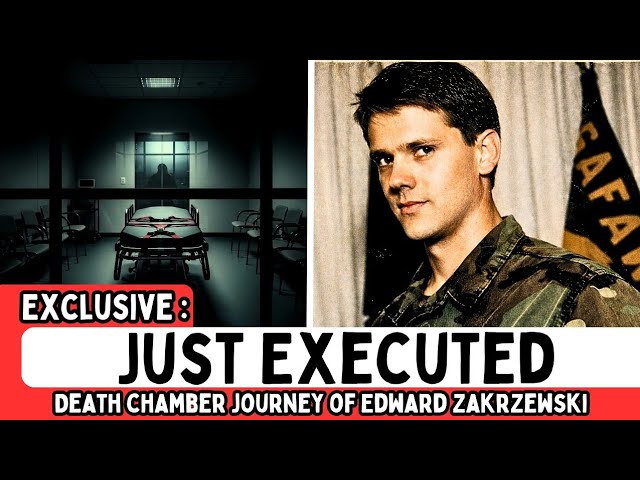
Zakrzewski’s final statement carried a chilling, ironic echo of his sentencing. “I want to thank the good people of the Sunshine State for killing me in the most cold, calculated, clean, humane, efficient way possible,” he said. “I have no complaint.” The word “calculated” was the precise term used by Circuit Judge G. Robert Barron in 1996 to describe Zakrzewski’s premeditated slaughter of his wife, Sylvia, 34, and their two young children, Edward III, 7, and Anna, 5.
The crime scene discovered on June 13, 1994, inside the family’s modest home on Shrewsbury Road near Eglin Air Force Base was described by veteran prosecutors and investigators as the worst of their careers. Yet, the quest for justice for Sylvia, Edward, and Anna unfolded almost entirely outside the national spotlight. Their murders were discovered the same week the nation became transfixed by the O.J. Simpson white Bronco chase, an event that consumed media attention and left this family’s tragedy buried.
The path to Thursday’s execution spanned 31 years of appeals, all ultimately rejected. Zakrzewski pleaded guilty in 1996 to three counts of first-degree murder, but a jury deadlocked on a death sentence for the killing of his daughter Anna, voting 6-6. Judge Barron overrode that deadlock, imposing death for all three murders—a judicial power that no longer exists under current Florida law. Today, a non-unanimous jury recommendation for death is prohibited, and a judge cannot override a jury’s life sentence.
This legal discrepancy formed the core of Zakrzewski’s final appeals. Attorneys and groups like Floridians for Alternatives to the Death Penalty argued that under the state’s present statutes, his jury’s 7-5 and 6-6 votes would have mandated life imprisonment. Every court, including the U.S. Supreme Court, in a final denial on July 30, rejected that argument, holding that the sentence was legal when it was imposed.

The murders were the culmination of a disintegrating marriage and Sylvia’s plans to return to her native South Korea with the children. Court records and testimony revealed that on June 9, 1994, Zakrzewski’s son, known by his Korean middle name Kim, called his father at work to relay his mother’s divorce plans. Unbeknownst to the boy, his father had already withdrawn over $5,400 the night before and had begun planning.
During his lunch break that day, Zakrzewski purchased a machete. He returned home, sharpened the blade, cut a length of rope, and positioned a crowbar in the bedroom. After completing his shift at Eglin, he returned home, attacked Sylvia with the crowbar without argument, and strangled her with the rope. He then called each child separately into the bathroom. Autopsies revealed that both children had defensive wounds on their arms and hands.
After the killings, Zakrzewski washed, changed clothes, and went to a bar. Found passed out in his car later, he was briefly detained by police, who did not know the carnage at his home. The next day, he flew to Hawaii, where he lived under an alias for four months until his capture was prompted by a segment on “Unsolved Mysteries.”

At his penalty phase, defense attorneys cited his military service and a claimed religious conversion, arguing he killed the children out of a twisted “mercy,” fearing they would face discrimination in Korea. Prosecutors, led by then-Assistant State Attorney Bobby Elmore, methodically detailed the cold, premeditated steps, from the weapon purchase to the bank withdrawal, and presented Zakrzewski’s own writings referencing philosopher Friedrich Nietzsche, countering the narrative of remorse.
Outside the prison before the execution, a small group held a prayer vigil advocating for clemency. Inside, only one visitor came, their identity undisclosed. No family members for either Zakrzewski or his victims attended. One man who did make the four-hour journey was retired Detective Joe Nelson, the lead investigator who had worked the case from the first day in 1994 and had never before witnessed an execution.
“It’s over now,” Nelson stated tersely to reporters afterward. “It needed to stop.” His presence underscored the enduring weight of a case that, while overshadowed in 1994, was never forgotten by those who worked it. The execution sets a somber benchmark for Florida, equaling a yearly total not reached in nearly 50 years and closing a final chapter on a crime of heinous cruelty that robbed a mother and her two children of their futures.