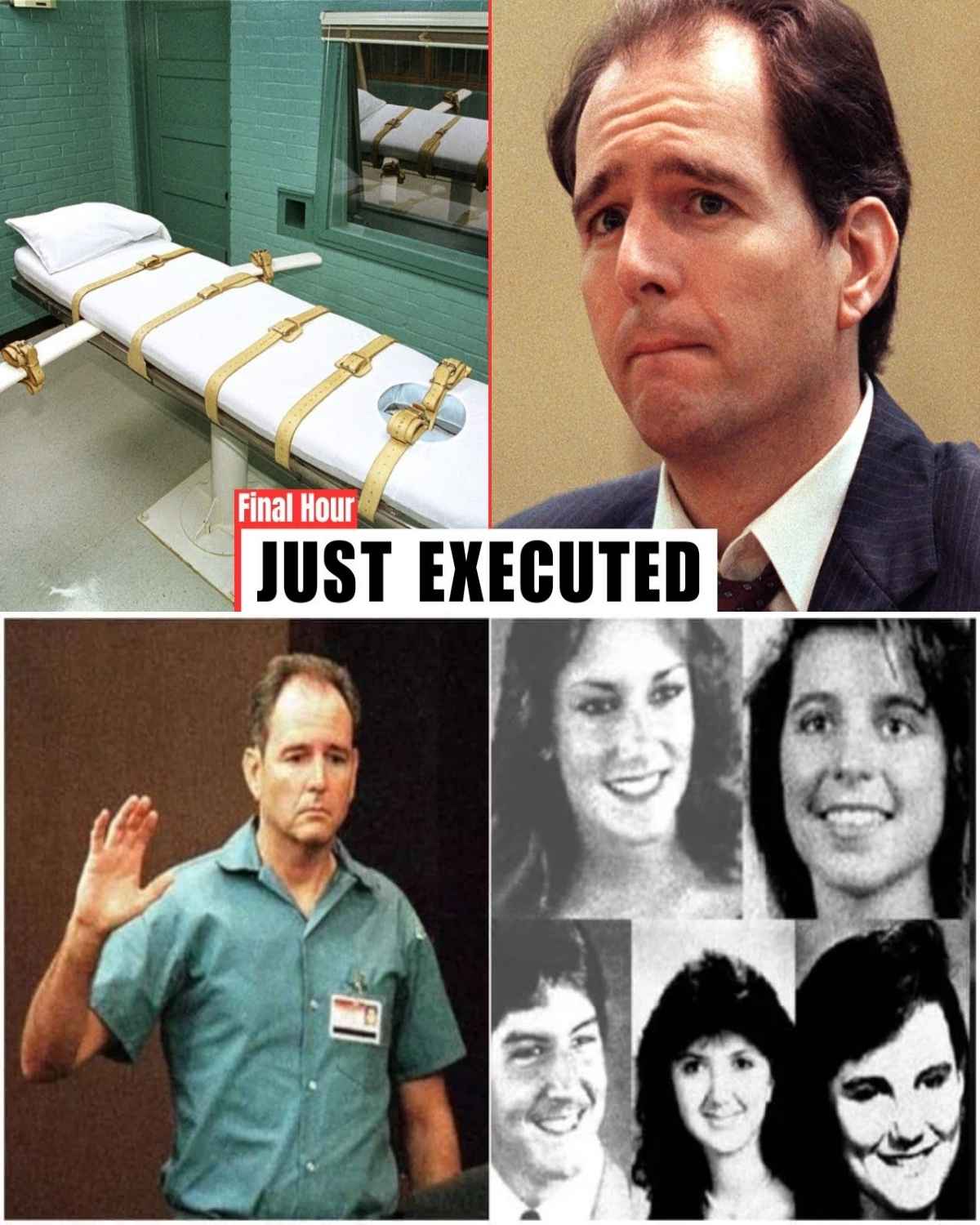
A city’s promise of new beginnings has been shattered by the final justice for its tormentor. Danny Harold Rolling, the serial killer whose brutal 1990 murders terrorized the University of Florida campus and stunned the nation, was executed by lethal injection at Florida State Prison on October 25, 2006. He was 52.

His death at 6:13 p.m. closed a chapter of profound horror for the families of eight victims. Rolling offered no final public statement, but in his last hours, he handed a pastor a handwritten note confessing to a triple murder in Shreveport, Louisiana, that had remained officially unsolved for 17 years.
The execution brought a grim end to a saga that began over three terrifying days in August 1990. As students arrived in Gainesville for the fall semester, a predator was already hunting. The bodies of five young people were discovered in their off-campus apartments, victims of unimaginable violence.
Christina Powell, 17, and Sonia Larson, 18, were found first on August 24th. Christa Hoy, 18, was discovered decapitated in her home the next day. Two days later, Tracy Paules and Manuel Taboada, both 23, were murdered. The killer posed his victims, leaving a community paralyzed by fear and a nation watching in dread.
The investigation consumed law enforcement. The break came not from forensic brilliance at the murder scenes, but from Rolling’s own reckless greed. Days after the killings, he robbed a Tampa grocery store. A botched escape led to his arrest on armed robbery charges.
While serving life sentences for that crime, a tip from a Louisiana acquaintance connected him to Gainesville. DNA evidence proved conclusive. Facing trial in 1994, Rolling stunned the court by pleading guilty to all five murders, stating he wished to spare the victims’ families a graphic trial.
A jury still convened for the penalty phase. They heard recordings of Rolling confirming gruesome details of the crimes through a fellow inmate. They learned of a childhood of extreme abuse at the hands of his father, a former police officer. Defense experts argued mental illness; the state countered he possessed a “Swiss cheese conscience.”
The jury recommended death. For twelve years, Rolling awaited execution on death row. The legal process played out as the full scope of his violence became clear. His confession through inmate Bobby Lewis revealed the Gainesville murders were not his first.
In his final written confession, he admitted to the November 1989 murders of 55-year-old William Tom Grissom, his 24-year-old daughter Julie, and his 8-year-old grandson Sean in Shreveport. Julie Grissom was raped and mutilated, a horrific precursor to the Florida crimes. Rolling had lived near the family.
The legacy of Rolling’s crimes extends far beyond the courtroom. Campus security protocols across the United States were fundamentally reevaluated in the wake of the Gainesville murders. The sense of invulnerability in college towns was permanently altered.
His crimes also seeped into popular culture, directly inspiring the Scream film franchise, which explored the vulnerability of teenagers and the mechanics of horror. The case remains a stark study in the genesis of violence, tracing a direct line from severe childhood abuse to adult psychopathy.
University of Florida President John Lombardi, reflecting on the case, captured its enduring scar: “On the one hand, we’re delighted there is closure… but on the other, nobody will have closure to the pain, to the loss, the scar it leaves on your soul.”
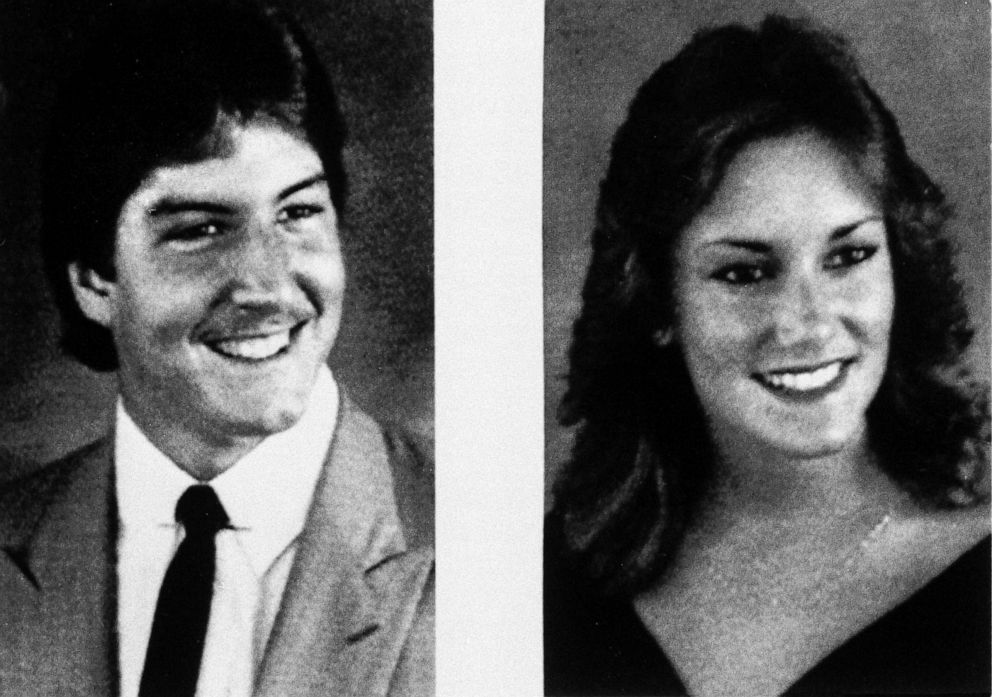
For the families of the victims—Christina Powell, Sonia Larson, Christa Hoy, Tracy Paules, Manuel Taboada, and the Grissom family—the execution ended the killer’s life but not their grief. Their loss permanently defines the caution and awareness that followed the late summer terror of 1990.
The final act was carried out with solemn procedure. Rolling was served his last meal: a roasted beef heart, symbolizing, he said, the theft of his victims’ hearts. He offered no apology to the families watching through the glass. The state’s machinery of justice, set in motion by his own monstrous actions, delivered its ultimate sentence.
The case of Danny Rolling endures as a grim lesson in forensic linkage, the catastrophic results of untreated trauma, and the fragile nature of safety. It stands as a reminder that monsters are not born in a vacuum, but their accountability for the horror they choose to enact must be absolute.