Timothy McVeigh, the infamous Oklahoma City bomber, met his end on June 11, 2001, executed by lethal injection in Terre Haute, Indiana. This marked the first federal execution in decades. In a chilling twist, McVeigh left behind no last meal, only a handwritten poem, “Invictus,” reflecting his defiance.

At 7:14 a.m., McVeigh was strapped to a gurney, IV lines ready. Witnesses, including survivors and victims’ families, gathered behind glass, a stark reminder of the horror he unleashed. The execution followed years of legal battles and public outcry, igniting debates over the death penalty and the nature of justice.
Six years earlier, on April 19, 1995, McVeigh carried out the deadliest act of domestic terrorism in U.S. history. A Ryder truck filled with 7,000 pounds of explosives detonated outside the Alfred P. Murrah Federal Building in Oklahoma City, killing 168 people, including 19 children. The blast shattered lives and left a city in ruins.
McVeigh’s motivations were rooted in a twisted ideology, fueled by anger over government actions at Waco and Ruby Ridge. He viewed the federal government as a tyrant, and his actions were a misguided attempt at revenge. But the consequences were devastating, leaving countless families shattered.
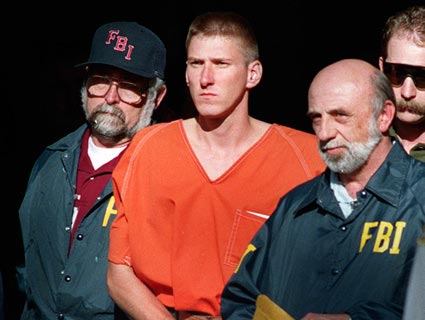
The investigation that followed was swift and relentless. Just 90 minutes after the bombing, McVeigh was pulled over for driving a car without a rear license plate. The state trooper discovered a concealed Glock, leading to his arrest. What started as a routine traffic stop unraveled into a national manhunt.
As evidence mounted, the FBI connected McVeigh to the bombing through meticulous forensic work. A truck axle traced back to the rental company and witness testimonies painted a clear picture of his involvement. His co-conspirator, Terry Nichols, was apprehended soon after, and their network began to unravel.
In a courtroom packed with survivors and families, McVeigh’s trial began in 1997. The prosecution painted a harrowing picture of the chaos he caused, while the defense attempted to portray him as a victim of government overreach. In the end, he was found guilty on all counts and sentenced to death.
His time on death row was marked by isolation and reflection. McVeigh consistently sought to expedite his execution, ultimately dropping his appeals. The final moments of his life were steeped in controversy, with many questioning the fairness of the judicial process that led to his death.
On that fateful morning in June, McVeigh’s final words echoed through the execution chamber, a haunting reminder of his unyielding belief in his actions. As his ashes were scattered in secret, the nation grappled with the legacy of his violence and the scars it left behind.
The repercussions of McVeigh’s actions continue to resonate, raising questions about domestic terrorism, government accountability, and the fragility of societal trust. As discussions around extremism and radicalization persist, the haunting memory of Oklahoma City serves as a stark warning of the depths of human rage.