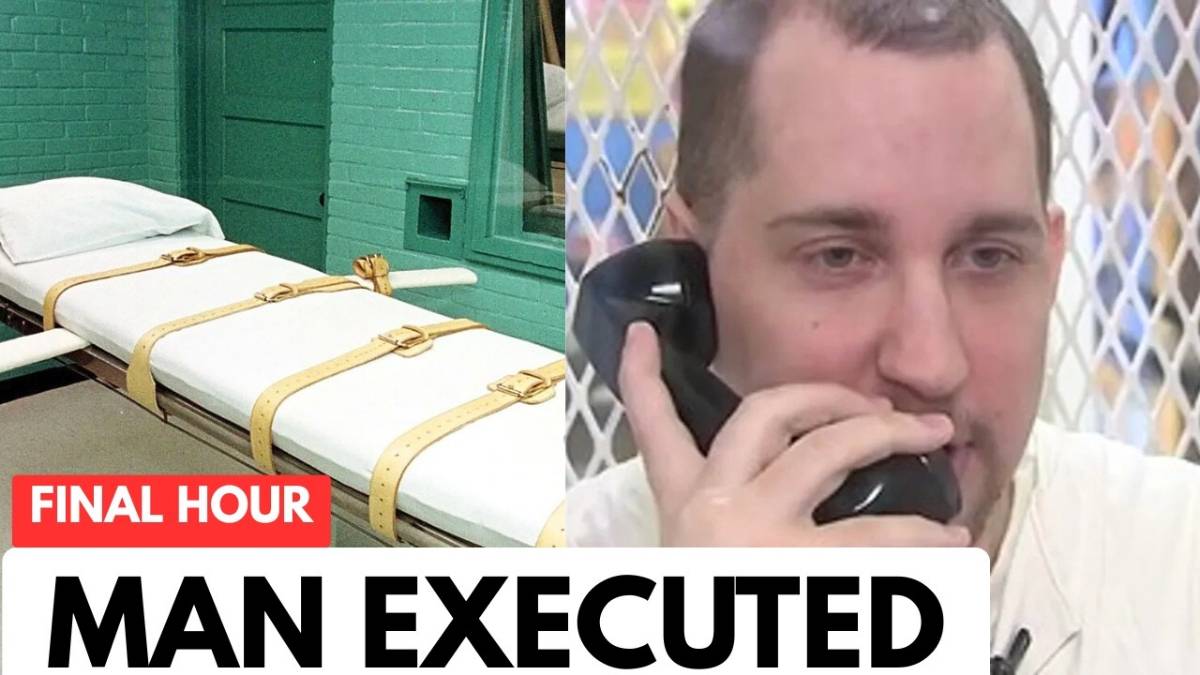
HUNTSVILLE, Texas — A Texas inmate who confessed to killing his three-month-old son and then spent years fighting to be executed was put to death by lethal injection Tuesday evening, closing a case that forced the legal system to confront profound questions of mental illness, justice, and redemption.
 Travis James Mullis, 38, was pronounced dead at 7:01 p.m. at the state penitentiary in Huntsville. He was executed for the 2008 murder of his infant son, Elijah, a crime he never denied and for which he ultimately sought his own punishment, waiving appeals in a fraught legal saga that lasted 13 years.
His final words were an apology and a testament to personal change. “I do regret the decision to take the life of my son,” Mullis said from the execution gurney. He thanked friends and prison staff, asserting that he and others on death row were not the same men who entered the system. “We have changed.”
The execution proceeded after a brief delay as technicians worked to insert an intravenous line. No last-minute appeals were filed. Mullis declined a final phone call with his attorney and ate a standard prison meal, Texas having abolished special last requests in 2011.
The path to the execution chamber began on a Galveston roadside in January 2008. Mullis, then 21, drove from Brazoria County with his infant son after a dispute with the child’s mother. The body of three-month-old Elijah was later discovered near Seawall Boulevard. The baby had suffered fatal blunt force trauma.
 Mullis fled Texas but surrendered days later at a Philadelphia police station. He provided written and videotaped confessions that prosecutors later described as nearly indefensible evidence of guilt. He told authorities he was seeking an ending.
At his 2011 trial in Galveston County, guilt was not contested. The jury instead grappled with whether Mullis represented a continuing future threat, a key question for imposing the death penalty in Texas. Prosecutors portrayed him as a dangerous manipulator beyond rehabilitation.
The defense presented a history of severe childhood trauma. Mullis was abandoned by his biological parents, adopted, and then subjected to intense physical and sexual abuse from age three. He was diagnosed with severe bipolar disorder and was in psychiatric treatment by elementary school.
The jury sentenced him to death. What followed was unprecedented. In 2012, Mullis instructed the court to drop all appeals. “I have always admitted guilt and justice is deserved for the victim’s family,” he wrote. A court found him competent to make that decision.

Thus began a decade-long legal conflict. Mullis reinstated and dropped appeals multiple times, later stating he had lied during competency evaluations due to mental illness and a terror of life in prison. His attorneys argued a severely mentally ill man could not ethically waive such protections.
Appellate courts at every level, including the U.S. Fifth Circuit Court of Appeals in 2023, ultimately rejected those arguments. The result was extraordinary: Travis Mullis was executed without any court ever conducting a full constitutional review of his conviction or his legal representation at trial.
In the years on death row, Mullis underwent a significant transformation, according to his legal team. He engaged with faith groups, mentored other inmates, and pursued what his attorney called “serious, sustained work” on himself.
 “The Travis that Texas wanted to kill is long gone,” defense attorney Shawn Nolan said in a statement released before the execution. “Texas will kill a redeemed man tonight.”
The state maintained that the execution delivered long-awaited justice. “Today marked the long-awaited fulfillment of a verdict rendered by a jury who heard all of the evidence,” said Galveston County District Attorney Jack Roady. He noted Elijah Mullis would have turned 17 next month.
Mullis became the fourth person executed in Texas this year and the 590th since the state resumed capital punishment in 1982. His final statement concluded with a philosophical note on the act that ended his life. “The morality of execution is between you and God,” he said. “It was my decision that put me here.”
The case leaves complex, unresolved questions about the intersection of severe mental illness, childhood trauma, and the legal standard for competency in waiving appeals. It challenges definitions of justice and redemption within the rigid framework of capital punishment.
At its center, however, remains the brief life of Elijah Mullis. The three-month-old infant, whose death his father confessed to and for which he ultimately chose to die, never had the chance to grow up along the Galveston seawall where his story violently ended.
Source: YouTube