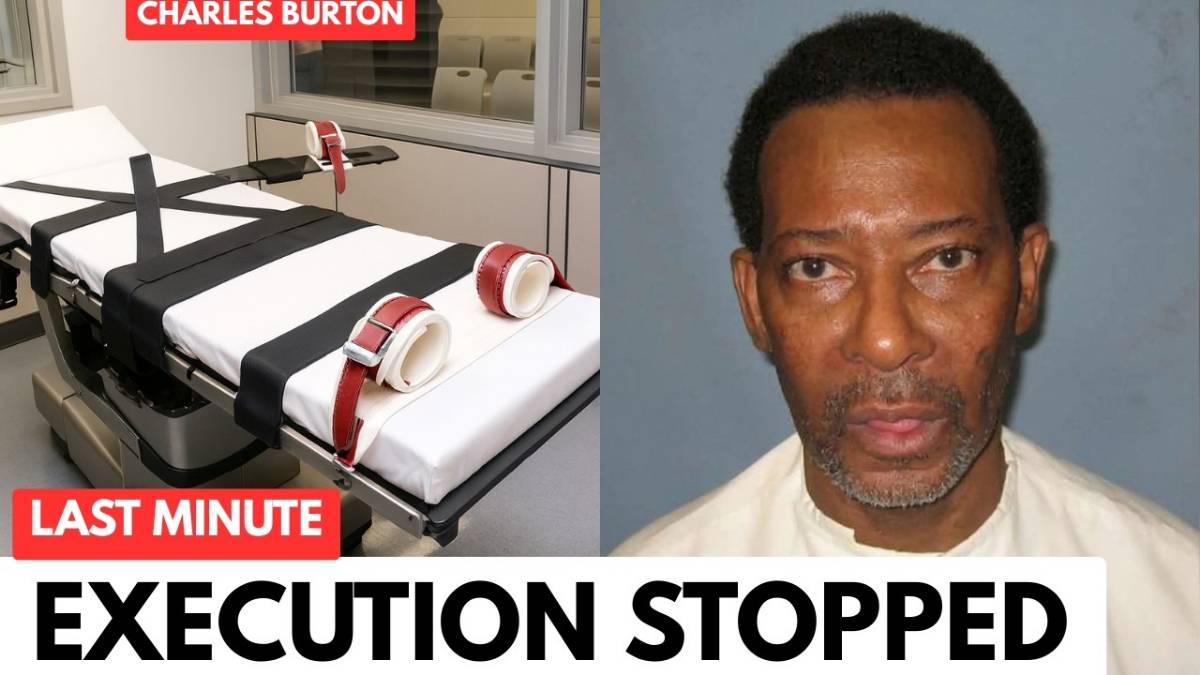
With only 48 hours remaining until his state-sanctioned death, Alabama death row inmate Charles Burton received a last-minute grant of clemency from the governor, an extraordinary intervention that commuted his sentence to life without parole. The 75-year-old man, who has spent more than half his life awaiting execution, was spared following a growing debate over the fairness of sentencing an accomplice to die when the actual killer will not.
 The Alabama prison system was in the final stages of preparation for the execution scheduled for March 12, 2026. Witnesses were being coordinated, and the elaborate protocol leading to lethal injection was underway. For over three decades, Burton had lived under the shadow of this moment, a countdown that began with a fatal robbery in Talladega County in 1991.
During that robbery, a store employee named Doug Battle was shot and killed. Investigators arrested multiple individuals connected to the crime, including Charles Burton. A critical fact, acknowledged by prosecutors at trial and which would echo for decades, was that Burton did not fire the fatal shot. Another man was identified as the triggerman.
Despite this, an Alabama jury convicted Burton of capital murder and sentenced him to death. His conviction rested on the state’s accomplice liability law, often called the felony murder rule. This legal doctrine holds all participants in a dangerous felony responsible for any death that occurs during the commission of that crime, regardless of who directly caused it.
Supporters argue the law creates a powerful deterrent, ensuring accountability for those who choose to engage in inherently dangerous acts. Critics contend it creates profound injustices by equating the culpability of a minor participant or accomplice with that of the actual killer, effectively removing the element of intent from sentencing.
For thirty years, Burton’s case wound through the appeals courts. Each legal challenge was reviewed and ultimately denied, leaving the original sentence intact. As the years passed, Burton aged from a middle-aged man into a frail, elderly prisoner, becoming one of the oldest inmates on Alabama’s death row.
The setting of an execution date this year brought the long-dormant case back into public view, highlighting a stark and, for many, troubling sentencing disparity. The man who prosecutors said fired the gun killing Doug Battle, the principal in the crime, is no longer on death row. His sentence was previously commuted to life imprisonment without parole.

This fact created the central, unresolved question that defined Burton’s final appeals and clemency campaign: How could the state justify executing the accomplice when the triggerman had been spared the death penalty? Burton’s supporters argued this outcome was not merely unequal but morally inverted.
The question eventually landed on the desk of Alabama Governor Kay Ivey. Known for her consistent support of capital punishment in a state with one of the nation’s highest per capita execution rates, she was an unlikely source of clemency. Grants of executive mercy in death penalty cases have become vanishingly rare across the United States.
After a review of the case file and the clemency recommendation from the state board, Governor Ivey intervened. With two days remaining, she signed an order commuting Charles Burton’s sentence to life in prison without the possibility of parole. The decision operates outside the judicial system, representing a sovereign act of executive power.
The governor’s office has not released a detailed statement, but the commutation order is believed to reflect the unresolved inequity between Burton’s sentence and that of his co-defendant. Burton will now live out his remaining years in a prison cell, but the state will not carry out his execution.
Legal experts note the decision is remarkable for its rarity. It underscores the unique and nearly absolute power of clemency, which exists as a final check on the judicial system when all legal appeals have been exhausted. This power is seldom used, especially in deep-red states like Alabama.

Reaction to the decision has been sharply divided. Advocates for the death penalty and members of Doug Battle’s family have expressed profound disappointment, arguing the jury’s verdict and three decades of judicial review should stand. They see the commutation as a betrayal of justice and a disrespect for the original legal process.
Opponents of capital punishment and criminal justice reformers hail the move as a necessary correction, a rare instance of mercy and moral clarity. They argue the case exemplified the arbitrary and often cruel nature of the death penalty, particularly under felony murder statutes.
The case also renews a national conversation about the felony murder rule itself. While nearly every state has some form of the law, several have recently moved to narrow its scope, especially for juveniles and those with minimal involvement in the underlying crime. Burton’s case may fuel further legislative review.
For Charles Burton, the immediate reality is a sudden and profound shift. After more than 11,000 days believing the state would kill him, he must now adjust to the certainty of dying naturally in prison. The psychological impact of such a last-minute reprieve is immense and largely uncharted.
Correctional officials confirm Burton has been moved from his death row cell to a different housing unit within the state prison system designated for inmates serving life without parole. The elaborate pre-execution protocols have been terminated, and the scheduled witnesses have been notified.

The debate this case ignites, however, will continue long after the headlines fade. Every grant of clemency forces a society to confront fundamental questions about justice, mercy, and the finality of state power. It asks whether the legal system, in its rigid application of rules, can sometimes lose sight of proportional fairness.
Governor Ivey’s decision does not overturn Burton’s guilt. He remains convicted of a brutal crime that ended an innocent man’s life. The commutation merely alters the state’s punishment, replacing a deliberate death with lifelong incarceration. For some, this is a compromise that acknowledges both the crime and the flawed sentencing outcome.
For the family of Doug Battle, the governor’s action likely feels like a second loss, a reopening of a wound they believed was finally about to close with the carrying out of a lawfully imposed sentence. Their quest for closure through the execution has been irrevocably denied.
As the American death penalty evolves, with fewer executions and growing bipartisan concern over its application, cases like Burton’s serve as critical inflection points. They test the boundaries of legal doctrine against evolving standards of decency and proportionality.
The machinery of death in Alabama, one of the most active execution states in the union, has been paused in this single instance. The governor’s pen proved mightier than three decades of court rulings. Yet, the reprieve for Charles Burton is an exception that proves the rule, highlighting just how relentless the standard process remains.
In the quiet of his new cell, an old man who prepared to die must now learn how to live again, within confines just as permanent but without a definitive expiration date. Meanwhile, the state and the nation are left to grapple with the difficult, unresolved question his case so starkly presents: did this clemency correct a systemic failure, or did it undermine the very foundation of justice?
Source: YouTube