A newly resurfaced ancient text, preserved for millennia against institutional suppression, claims to reveal the precise and immediate fate of the human soul after death, challenging foundational Western theological concepts. The Book of Enoch, a work quoted in the New Testament and revered by the earliest Christians, describes a structured afterlife where souls are sorted into specific chambers at the moment of death, long before any final judgment. This detailed geography, confirmed by modern archaeological discoveries, presents a radical departure from the vague concept of Sheol traditionally taught.
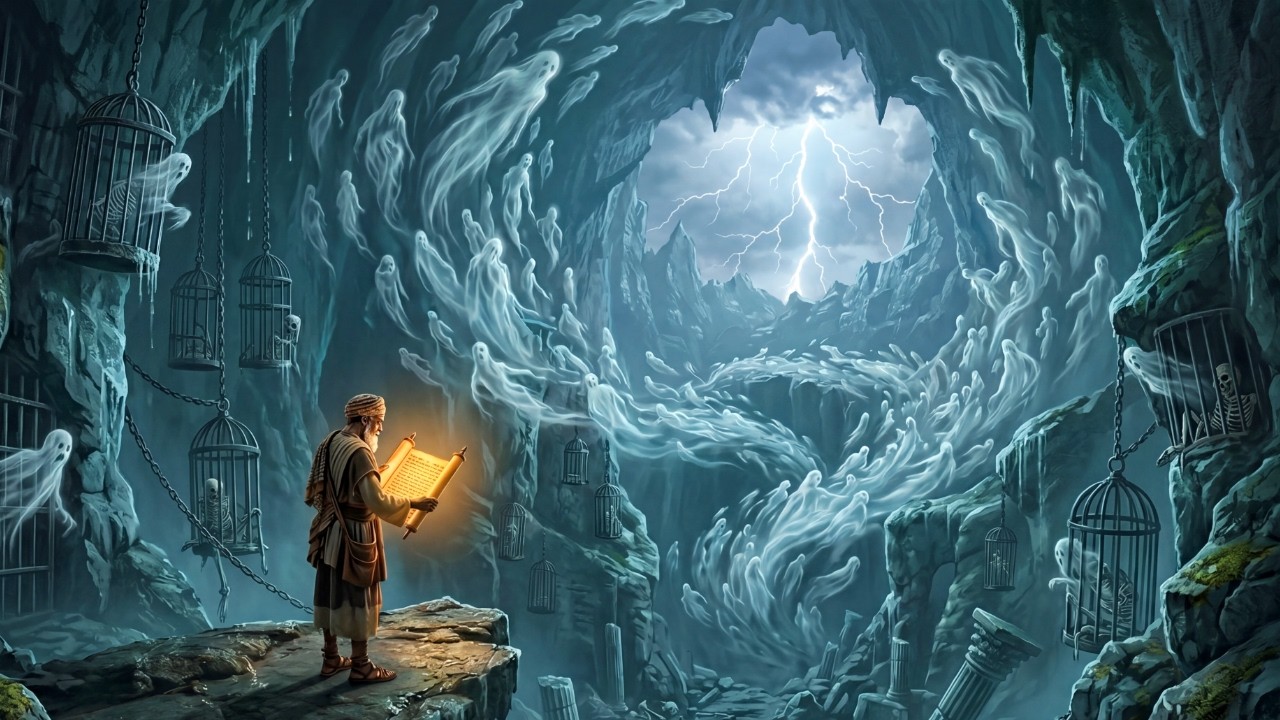
For over 1,400 years, this text was erased from Western Christianity, surviving only within the sacred tradition of the Ethiopian Orthodox Church. Its disappearance coincided with early church councils defining the biblical canon, leading many scholars to believe its contents were deemed too theologically disruptive to remain in circulation. The book’s meticulous account of the underworld, witnessed by the biblical patriarch Enoch during an angelic journey, suggests a pre-ordained divine justice operating independently of earthly religious authority.
Enoch’s journey, as recorded in chapters 22 through 27, reveals Sheol not as a singular, shadowy holding place but as a complex of four distinct hollows within a great mountain. Each chamber serves a different category of soul, with conditions reflecting the individual’s life and manner of death. This immediate post-mortem sorting implies a cosmic accounting that begins the instant life ends, a concept with profound implications for traditional views of judgment, intercession, and salvation.
The first chamber is described as a place of light containing a spring of water, where the righteous dead await in peace. The second holds the souls of those who were murdered or suffered injustice; they are depicted as actively crying out for vengeance, their petitions heard in real time. A third chamber contains those who lived in sin and died without repentance, existing in a silent, comfortless isolation.
The fourth and final compartment is reserved for the profoundly wicked. Enoch’s account states these souls are already in complete darkness and experiencing punishment, a clear assertion of immediate consequences preceding the final judgment. This structured, active underworld directly contradicts the notion of a uniform, dormant sleep of souls until the end times.

Astonishing parallels exist between this Enochian map and the teachings of Jesus. The parable of Lazarus and the rich man in Luke’s Gospel features identical elements: a great chasm, the presence of water for comfort, and differentiated conditions for the righteous and the wicked experienced immediately after death. Scholars now assert Jesus was referencing a cosmology his audience would have recognized from Enoch, a text widely read in the first century.
Central to this cosmology is the archangel Uriel, the “Light of God,” who guides Enoch and is identified as the guardian and record-keeper of Sheol. While venerated in Ethiopian tradition, Uriel was systematically marginalized in Western angelology, his functional role in the afterlife process effectively erased alongside the book that defined it. This removal of a specific celestial overseer further abstracted the mechanics of death.
The text’s most challenging elements may involve its detailed treatment of the “Watchers,” the fallen angels of Genesis 6. Enoch describes their imprisonment in a separate, adjacent abyss, a concept directly referenced by New Testament authors Jude and Peter. This expands the afterlife landscape to include imprisoned supernatural beings, presenting a cosmos of staggering complexity that institutional orthodoxy could not easily simplify or control.
The 18th-century rediscovery of complete Enoch manuscripts in Ethiopia and the 1947 discovery of pre-Christian Aramaic fragments among the Dead Sea Scrolls shattered academic skepticism. The Ethiopian church, isolated from the Western councils that rejected the book, had preserved it as canonical scripture, copying it by hand for over 1,700 years. The Dead Sea Scrolls proved their antiquity and their sacred status among a Jewish sect centuries before Christ.

This survival against systematic suppression suggests the content was considered not just heretical, but dangerously informative. A map of the afterlife that operates on automatic, immediate divine justice diminishes the role of institutional gatekeepers. The Enochian vision presents souls as conscious, active, and in a transformed relationship with the divine and the living from the moment of death.
The implications are immediate and personal. If Enoch’s testimony is engaged seriously, the paramount question shifts from securing posthumous intercession to understanding which chamber one’s current life is actively preparing them for. The text frames earthly existence as a formative process with direct and immediate consequences in the afterlife architecture.
Enoch himself, the man who “walked with God and was no more,” uniquely returned to report on the realm all others enter without return. His account forces a re-examination of the very foundations of afterlife theology. It suggests that core Christian teachings about hell, paradise, and judgment were originally rooted in a far more detailed and unsettling cosmic geography.
The Book of Enoch is now available, no longer confined to Ethiopian monasteries or desert caves. Its re-emergence challenges believers and scholars alike to confront an ancient, detailed map of the hereafter that the Western world tried desperately to forget. The archive, meticulously preserved against all odds, is now open, demanding a reckoning with its precise, disturbing, and geographically specific vision of what awaits on the other side of death.
Source: YouTube