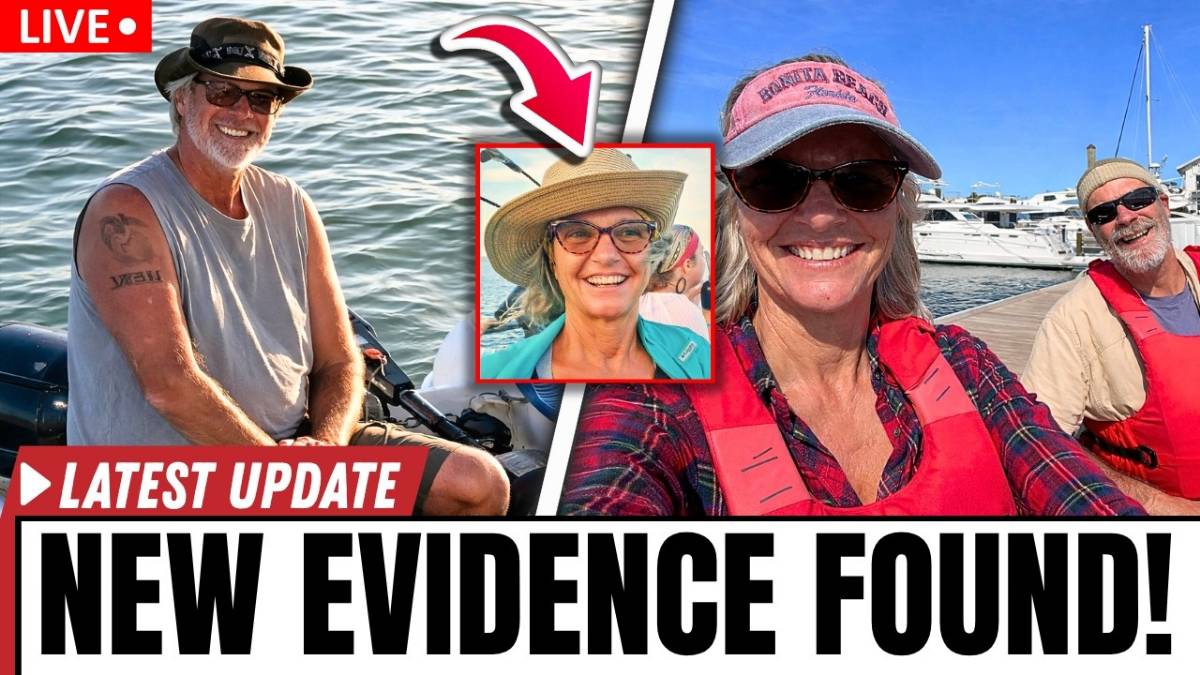
The silence from the Bahamas has been deafening, but a new piece of evidence has shattered it, placing the husband of missing Michigan woman Lynette Hooker directly under an intensified spotlight. Text messages obtained exclusively by this news organization reveal a history of violence that Lynette confided to a close friend, detailing a pattern of abuse that included being choked and threatened with being thrown overboard. This chilling revelation comes as authorities in the Bahamas continue to scrutinize Brian Hooker, the man who was the last person to see Lynette alive before she vanished into the dark waters off the coast of Abaco on April 4th, 2026.
 The text messages, which have been verified by our team, paint a harrowing picture of a marriage that was far from the idyllic sailing adventure portrayed on the couple’s popular social media page, Sailing Hooker. In these private communications, Lynette described a specific incident where her husband choked her, a moment of terror that she linked directly to a separate event involving their daughter. The message reads, in part, “There’s history of him choking her out and threatening to throw her overboard, so when he choked his daughter, she had to pay.” This single sentence connects a pattern of domestic violence to a financial motive, suggesting that Lynette was forced to cover legal bills for a criminal trial related to that very act.
This new evidence does not exist in a vacuum. It is the latest and most damning piece of a puzzle that has been slowly assembling since the moment Lynette disappeared. For weeks, the official narrative has been one of a tragic accident, a routine dinghy ride that went horribly wrong. Brian Hooker has maintained that his wife fell overboard, the engine key fell with her, and that he was helplessly pushed away by wind and current, unable to save her. But the text messages, combined with a growing chorus of voices from Lynette’s past, are forcing investigators and the public to ask a far more disturbing question: Was this an accident, or was it the culmination of years of fear and control?
The story of Lynette Hooker is not one that begins with a splash in the ocean. It begins, as many stories of hidden suffering do, with a mother. Darlene Hamlet, Lynette’s mother, has broken her silence after 25 years of watching her daughter’s life from a distance, a life she now believes was a carefully constructed facade. “Not every story begins with evidence,” she said in an exclusive interview. “Sometimes it begins with a mother. A mother who stayed silent for 25 years until one moment that forced her to speak. Because what she revealed wasn’t just grief. It was a different version of a life the world thought it already understood.”
On the surface, the world saw a fairy tale. Lynette and Brian Hooker were the face of a dream, a couple who had traded the rat race for a life of freedom on the open sea. Their YouTube channel and social media pages were filled with sun-drenched images of turquoise water, boat repairs, and shared laughter. They were a team, a partnership that seemed unbreakable. Thousands of followers watched as they navigated from Texas to Florida and down into the Caribbean, living a life that felt authentic and aspirational. There was no hint of the darkness that Lynette’s text messages now reveal.

But behind the camera, a different story was being written. One that almost no one saw. Lynette’s daughter, Carly Ellsworth, has been the most vocal in challenging the public perception. She has described a relationship that was not always safe, not always stable. “There’s history of him choking her out,” Carly has stated, echoing the text messages. She has spoken of arguments that turned physical, of a mother who felt threatened, and of a pattern of control that she believes was hidden from the world. For Carly, the events of April 4th are not a random tragedy but a potential consequence of a dynamic she had witnessed for years.
The timeline of that night is now under intense scrutiny. According to Brian Hooker, he and Lynette were in a small dinghy, a short trip that was routine. He says Lynette went into the water, and in the same instant, the key to the engine fell with her. Without power, he claims the wind, which was blowing at 18 to 22 knots, pushed the dinghy away. He says he tried to get back, fired a flare, and then drifted for nearly seven hours before reaching shore near Marsh Harbour. His account is consistent: “The wind pushed me away. She swam toward the sailboat. And then we lost each other.”
On its surface, the sequence appears logical. A fall. A lost key. Mechanical failure. Environmental conditions. Each piece on its own makes sense. But when placed together, some details begin to stand out as gaps, moments where different choices could have been made. Carly Ellsworth has zeroed in on these gaps with the precision of someone who has spent every waking moment replaying the scenario. Her first question is immediate and direct: “Why didn’t he drop anchor?” In open water, when someone disappears, every second matters. Stopping the boat, holding position, can mean the difference between staying within sight or losing it entirely.
 Her second question is equally pointed: “Why didn’t he stay and keep searching?” Even without an engine, there are options. You can slow movement. You can attempt to maintain proximity. You can focus entirely on the last known location. But instead, the gap widened. Distance replaced visibility. And visibility is everything in a situation like that. Then comes the third question, the one that, for Carly, changes the tone of the entire story. “Why did he move in the opposite direction?” Not toward where Lynette had entered the water, not toward the sailboat they had been traveling from, but away, carried by the current, eventually rowing toward shore.
For Carly, this is not a small detail. Direction is not just geography; it reflects intent. “If the person I love falls into the ocean,” she said, her voice tight with emotion, “I don’t leave. I stay. Even if I can’t reach them, I stay.” That statement does not accuse, but it draws a line between instinct and action. And for her, that line is difficult to reconcile. Her concerns do not stop with what happened on the water. They extend to the moment she first received the call from Brian Hooker, the moment everything became real. She describes the call as short, controlled, almost too calm. There was no urgency in the voice, no sense of panic, no emotional weight that matched the situation. Just a sequence of facts. A life raft had been found. Lynette had not. And then, the call ended.
To understand what may have happened that night, investigators did not just look at statements. They looked at the environment. The wind that evening ranged between 18 to 22 knots, strong enough to push a small vessel off course in seconds. The waves were estimated at around one meter, not extreme by ocean standards, but more than enough to disrupt visibility and balance in a small dinghy. Darkness did not arrive gradually; it fell quickly. Within minutes, the horizon would have disappeared, replaced by shadows, movement, and uncertainty. In those conditions, experts say, a person in the water can vanish from sight almost immediately, not because they go far, but because the human eye simply loses reference.

From a purely environmental perspective, this part of the story is plausible. A sudden fall, a loss of visual contact, rapid separation caused by wind and current. It happens. And when it does, recovery becomes extremely difficult. But even with that understanding, the conditions do not explain everything. Because while the environment may account for the disappearance itself, it does not fully account for the actions that followed. Wind can push a boat. Waves can limit visibility. Darkness can erase distance. But they do not make decisions. They do not determine direction. They do not explain why certain actions were taken and others were not. And that is where the focus begins to shift from what the ocean did to what happened after.
If the night at sea raised questions, the past begins to explain why those questions will not go away. Long before April 4th, there were people who had already seen a different side of this relationship. Their accounts, though separate, begin to overlap in ways that are difficult to ignore. For Carly Ellsworth, the concern did not start with the disappearance. It had been building over time. She has spoken about a relationship that, from her perspective, was not always safe. There were moments, she said, when arguments went beyond words, when they became physical. She described hearing about incidents where her mother felt threatened, moments where control seemed to shift. And in one account she shared, there were references to behavior involving physical restraint, including claims that Lynette had been choked during an altercation.
Her mother, Darlene Hamlet, offered a different perspective, one shaped by years of observation. She did not describe one specific incident. She described a cycle. According to Darlene, the relationship moved in repeated phases: separation, distance, then return. Over and over again. She recalled periods where Lynette would leave, only to come back months or years later, each time hoping things would be different, each time trying to rebuild. But in her view, the underlying dynamic never truly changed. Darlene also spoke about moments where Lynette appeared with visible signs that something had happened, marks that raised concern, details that were never formally reported but were remembered. And in one instance she described, Lynette confided that she had been physically restrained during a confrontation.
 Neighbors added another layer. One neighbor, Jordan Pence, described the relationship as tense at times, with arguments that could be heard or sensed from nearby. He spoke about disagreements that did not seem minor, moments that felt prolonged and emotionally charged. While he did not claim to witness specific acts of violence directly, his account supports the idea that conflict was not rare, that it was part of the environment. Then there is the official record. In 2015, police were called to the couple’s home in Michigan following a reported domestic incident. Both individuals described a physical altercation. Each gave a different account of what had happened. There were no clearly documented injuries at the time, and no charges were filed.
From a legal standpoint, the case ended there. But when viewed alongside the accounts from family and neighbors, it becomes something else. Not a conclusion, but a data point. One that aligns with a broader pattern being described. Taken together, these perspectives do not provide certainty. They do not establish a definitive timeline of events, but they do challenge one key assumption: that this was a perfect relationship. Because when multiple voices from different positions, over different periods of time, begin to describe similar dynamics, it becomes harder to dismiss. What once appeared calm and stable now reveals signs of strain. What once looked complete now appears divided. And that shift in understanding may be critical, not just to the past, but to what happened next.
At this point in the story, two versions of the same relationship begin to emerge. One that the world saw, and one that, according to those closest to Lynette, was never fully visible. On the surface, the narrative was clear: a couple living freely at sea, traveling from one coastline to another, sharing a life built on movement, simplicity, and independence. Through the Sailing Hooker pages, that image was consistent. They worked together. They laughed together. They built something that appeared stable, a partnership that many people admired. But beneath that surface, another version was quietly unfolding. One shaped not by freedom, but by tension. Not by balance, but by imbalance. Accounts from family and those around them describe a relationship marked by cycles of conflict, periods of separation, moments of control, and, at times, behavior that raised serious concerns.
Two narratives existing at the same time. One shared publicly. The other experienced privately. And the distance between those two versions may be one of the most important elements in understanding this case. Because when a relationship presents one image to the world, and lives another behind closed doors, it creates a gap. A gap where critical details can remain hidden. And sometimes, that gap only becomes visible after something goes wrong. But beyond emotional dynamics, there is another layer that begins to take shape. One that is less visible, but potentially just as significant: the financial structure of the relationship. According to Lynette’s mother, Darlene Hamlet, this was not a shared system. It was a one-sided one.
For years, she says, Lynette was responsible for nearly everything. Daily living expenses. Maintenance and repairs for the boat. Equipment needed to sustain life at sea. Even legal costs, including those from past proceedings. The pattern, as described, was consistent. When there were financial gaps, Lynette filled them. When stability was needed, it came from her. Meanwhile, Brian’s income, according to these accounts, was not steady. And much of it was directed toward obligations outside the relationship, including responsibilities from previous commitments. This created an imbalance, not temporary, but sustained. Month after month. Year after year. Over time, that imbalance became part of the foundation itself. From the outside, the life they built appeared shared. But according to those closest to Lynette, the structure supporting that life was not.
And that distinction matters. Because in cases where there is no clear physical evidence, investigators often turn to something else: motive. And financial patterns, long-term, consistent, measurable patterns, can play a critical role in understanding that. This does not provide answers, but it reframes the questions. Because when one person carries the weight of a relationship for decades, financially, emotionally, structurally, it changes how that relationship is viewed. And it raises one question that becomes harder to ignore. If that structure suddenly disappeared, who would be affected? And who might benefit from it? Looking back, there is one earlier chapter that investigators and observers continue to revisit. In 2006, Brian Hooker was formally charged in a case involving serious allegations. The details of that case were examined in court, and ultimately, he was acquitted.
 From a legal standpoint, that outcome is clear. The charges did not result in a conviction. But for Lynette’s family, another detail from that period stands out. Not the verdict, but the financial burden surrounding it. According to Darlene Hamlett, the legal defense, attorneys’ fees, court-related costs, and associated expenses were covered by Lynette. Not partially, but fully. That detail, in their view, aligns with a broader pattern already described. When financial pressure appeared, Lynette absorbed it. When stability was needed, it came from her. And over time, that role did not shift. It became the structure of the relationship itself. This history does not establish wrongdoing, but it does reinforce a consistent dynamic, one that continues into the present.
Because today, the focus has shifted from the past to an active investigation. Following Lynette’s disappearance, authorities in the Bahamas detained Brian Hooker for questioning. He was taken into custody on suspicion related to the circumstances surrounding her disappearance. However, as of now, no formal charges have been filed. That distinction is important. Detention allows investigators to examine inconsistencies, gather statements, and evaluate available evidence without yet moving to prosecution. His legal representation has stated that he denies any wrongdoing and has described him as cooperating with authorities. At the same time, the scope of the investigation has expanded. It is no longer limited to a single account of events. Instead, multiple layers are being reviewed.
The vessel itself, its condition, movement, and mechanical state, is being examined. Digital data, including communications, timelines, and device activity, is being analyzed. Financial records are being scrutinized to understand long-term patterns and recent changes. And insurance structures are being investigated to determine whether any policies may be relevant to the case. In situations where physical evidence is limited, these forms of data often become central. They provide something that statements alone cannot: consistency, traceability, and in many cases, motive. At this stage, the investigation remains open. No definitive conclusion has been reached, but the direction is becoming clearer.
As of now, Lynette Hooker has not been found. There is no definitive physical evidence. No clear moment that explains everything. But that does not mean there is nothing. Because piece by piece, details are coming together. In cases like this, where there is no body, no direct proof, the truth does not disappear. It changes form. It moves away from words and into things that cannot be altered. Financial records, cash flow, digital timelines, things that do not rely on memory or interpretation. Things that remain even when everything else is uncertain. And while the ocean has yet to return answers, the investigation on land continues to move forward. Quietly, methodically, step by step.
Lynette’s family has not stepped back. They continue to speak, to ask questions, to keep pressure where it matters. Because in complex cases, justice is rarely immediate. But when it comes, it is built on evidence, not assumptions. And that is where the hope lies. Not in speculation, not in theory, but in the fact that the search is still active, that every detail is still being examined, and that the truth, however long it takes, has not been abandoned. So, the question remains, what truly happened that night in the water? And who stands to benefit from Lynette’s disappearance? The answers may not be visible yet, but they may already exist, hidden in the data, in the texts, and in the silence of a man who was the last to see her alive.
Source: YouTube