A Texas execution chamber delivered final justice Thursday night for one of the state’s most senseless and brutal killing sprees, as Michael James Perry was executed by lethal injection for the 2001 murders of three people during a car theft that spiraled into unimaginable violence.
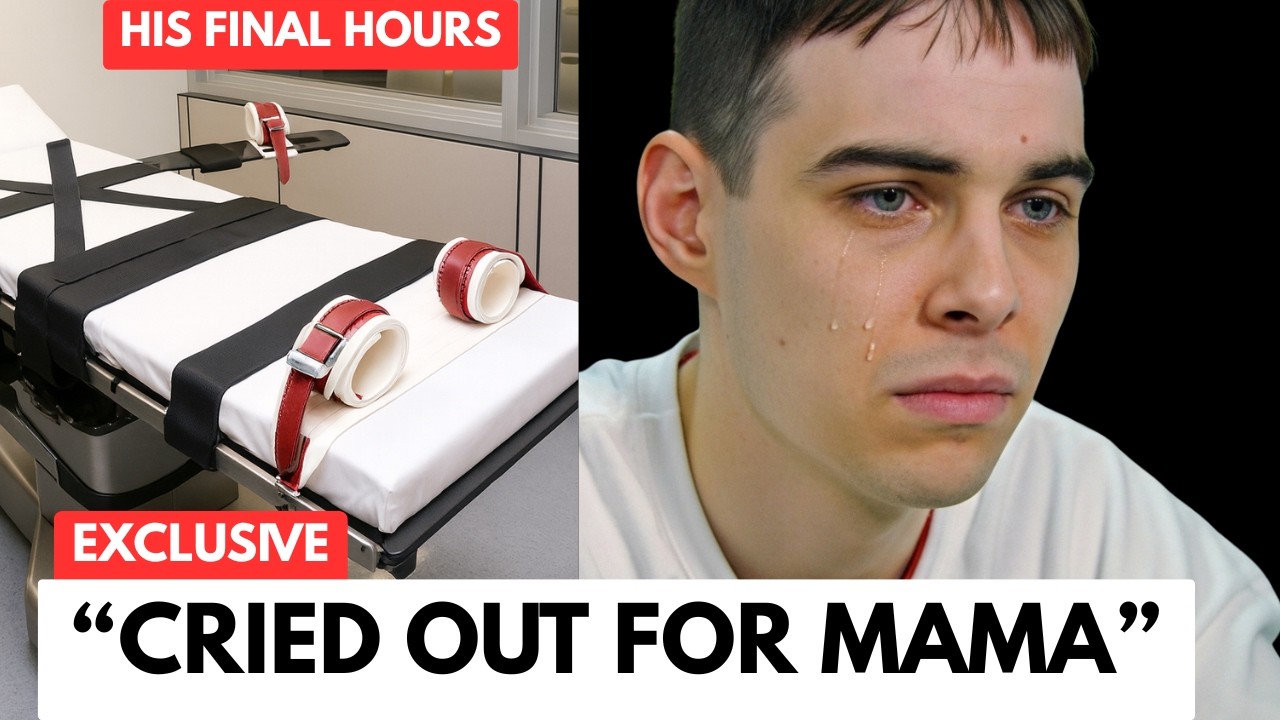
Perry, who was 19 at the time of the crimes and became the youngest inmate on Texas’s death row, was pronounced dead at 6:17 p.m. at the state penitentiary in Huntsville. His execution proceeded after the U.S. Supreme Court rejected a final appeal just ninety minutes earlier, exhausting all legal avenues.
The case, which horrified the quiet community of Conroe, Texas, began on October 24, 2001, with the cold-blooded murder of 50-year-old nurse Sandra Stotler. Perry, along with accomplice Jason Burkett, shot Stotler twice with a shotgun in her own kitchen after she answered a knock at her door.
Their motive was chillingly simple: to steal her prized red Chevrolet Camaro. When they could not immediately find the car keys, their plan escalated into a premeditated trap for Stotler’s 17-year-old son, Adam, and his friend, 18-year-old Jeremy Richardson.
“These were executions,” lead prosecutor Mike McDougall stated during the trial. “They lured those boys to the woods under the guise of helping an injured friend and shot them down.”
After murdering the two teenagers in a secluded wooded area, Perry and Burkett embarked on a six-day spree, brazenly partying with the victims’ money and showing off the stolen vehicles. Perry was initially arrested after a high-speed chase in the Camaro, but was released after fraudulently using Adam Stotler’s identity.
The investigation unraveled when Stotler’s body was discovered in Crater Lake and police connected the stolen car to the homicide. A key break came from Burkett’s girlfriend, Kristen Willis, who cooperated with authorities despite a direct death threat from Perry.
Perry ultimately confessed in graphic detail to paramedics while being treated for injuries from a second crash, directing police to the bodies of Adam Stotler and Jeremy Richardson. He later recanted, but his recorded confession and overwhelming physical evidence sealed his conviction in 2003.
During his trial, Perry’s decision to testify proved disastrous. His arrogant, remorseless demeanor and inability to explain how he knew intimate crime scene details alienated the jury, which returned a guilty verdict after only two hours of deliberation.

Asked for a final statement while strapped to the execution gurney, Perry offered no apology to the victims’ families. “I want to start off by saying to everyone involved in this atrocity, they are all forgiven by me,” he said, framing his own execution as the wrongdoing.
He then told his mother he loved her and whispered, “I’m coming home, Dad.” Witnesses reported a single tear rolled down his cheek as the lethal injection began.
For the victims’ families, who watched through the chamber window, the execution ended a nine-year legal ordeal. “We can get on with our lives now and have peace,” said Mary Delgado, Sandra Stotler’s mother.
Lisa Balon, who lost both her mother and brother, stated she needed to see Perry’s eyes. “Apparently, he is,” she said of the monster she had imagined. “Even at the end, he showed no remorse.”
Perry’s accomplice, Jason Burkett, was convicted separately. After emotional testimony about his traumatic childhood, he received a life sentence and narrowly avoided the death penalty.
The case attracted international attention and was the subject of Werner Herzog’s 2011 documentary, “Into the Abyss: A Tale of Death, A Tale of Life.” Herzog, an opponent of capital punishment, nevertheless found the evidence of Perry’s guilt to be overwhelming.
Throughout his years on death row, Perry maintained his innocence and attracted a small group of supporters who questioned forensic timelines. Prosecutors and courts consistently dismissed these claims, pointing to the incontrovertible evidence.
“The physical evidence, his confession, his actions afterward—driving the victims’ cars, bragging about the murders—created a mosaic of guilt that was impossible to refute,” said former detective Alan Hill, who worked the case.

The crime spree laid bare a tragic collision of worlds: a dedicated nurse and two promising teenagers against two young men from disparate backgrounds united by drug use and escalating criminality. Perry, adopted into a middle-class family, had been given numerous interventions that failed.
Psychiatrists testified to his diagnoses of ADHD, oppositional defiant disorder, and conduct disorder, but prosecutors argued he had consciously chosen a path of violence and manipulation.
“The defense of a troubled childhood only goes so far,” McDougall argued during sentencing. “At some point, personal accountability must take precedence. He was given chance after chance and chose to commit evil.”
The execution closes one chapter in a story that forever altered multiple families and a community. Sandra Stotler, remembered as a compassionate nurse; Adam Stotler, a protective son with his future ahead of him; and Jeremy Richardson, a loyal friend beginning adulthood—their lives were extinguished for a material possession.
“The red Camaro was just a car, metal and glass that could be replaced,” Balon said in a prior statement. “But my mother’s life, my brother’s life, and Jeremy’s life could never be replaced. They were unique, irreplaceable, infinitely valuable.”
With the carrying out of the sentence, Texas has now executed 464 inmates since the reinstatement of the death penalty in 1976. Perry’s case will stand as a stark reminder of how quickly criminal intent can escalate and the enduring, painful search for justice that follows in its wake.
As the witnesses departed the Huntsville unit Thursday night, a profound silence settled where years of legal arguments and raw grief had resonated. The state’s machinery of justice had completed its task, but the human cost, as all agreed, remained immeasurable.
Source: YouTube