In a stunning declaration that has reignited one of history’s most profound mysteries, actor and filmmaker Mel Gibson has presented a forceful case for the authenticity of the Shroud of Turin, citing a convergence of scientific and historical evidence that he claims directly links the linen to the crucified Jesus Christ. Gibson’s detailed assertions, made during a recent appearance on The Joe Rogan Experience, challenge decades of skepticism and point to findings he describes as “nearly irrefutable.”

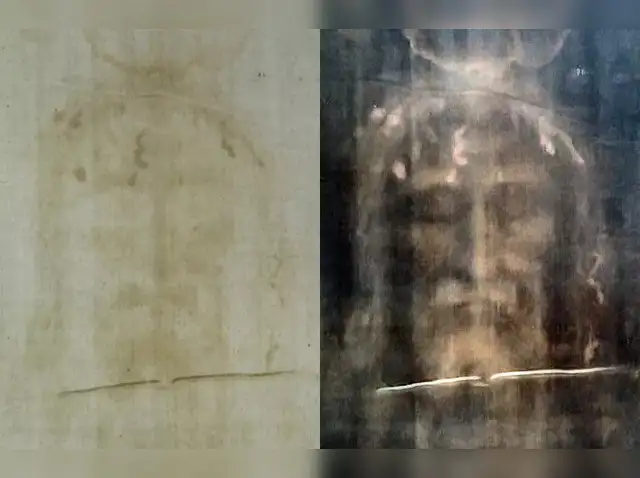
The shroud, a 14-foot linen cloth bearing the ghostly image of a crucified man, has been the subject of intense debate for centuries. Gibson, known for his meticulous research on the film The Passion of the Christ, stated the forensic details encoded in the fabric align with biblical accounts of Jesus’s torture and death with uncanny, inexplicable precision. His conviction, drawn from consultations with scholars and scientists, presents the artifact not as a medieval forgery but as a legitimate object of scientific inquiry.
“The image shows a man who was scourged, pierced by thorns, and nailed through his hands and feet,” Gibson asserted, describing wounds that match Gospel descriptions. He emphasized details like the hairstyle reflecting first-century tradition and the specific weave of the fabric, consistent with burial cloths from the era. These elements, he argued, would have been beyond the knowledge of any hypothetical medieval artist.
Perhaps the most startling claim involves the eyes. Gibson revealed that an archaeologist who assisted him discovered faint imprints over the eye sockets consistent with coins placed on the deceased, a known Jewish burial custom. Analysis reportedly suggests these markings align with coins minted under Pontius Pilate in the first century, precisely dating the burial to the time of Christ’s crucifixion.
Scientific analysis of pollen embedded in the linen further anchors the shroud to the correct historical and geographical context. Researchers have identified pollen from plants native to ancient Palestine, some now extinct, dating back approximately 2,000 years. This botanical evidence presents a formidable challenge to the theory of a later European forgery, as a medieval creator could not have replicated such specific, microscopic details.
The nature of the image itself remains a central enigma. Experts agree it is not a painting. Advanced photographic analysis in 1898 revealed the cloth acts as a photographic negative, with the image containing three-dimensional data. The exact process that created this faint, full-body imprint—a phenomenon some scientists have theorized required a brief, intense burst of radiant energy—has never been replicated. Gibson also highlighted the blood evidence. Tests have identified the stains as type AB, a detail he connects to other purported Eucharistic miracles. The pattern and serum rings around the wounds indicate real human blood flowed from the body before the image was formed, a sequence impossible for an artist to forge with medieval techniques.

The filmmaker addressed the controversial 1988 carbon-14 dating that placed the shroud in the Middle Ages, calling those results into serious question. He noted the sample tested was taken from a corner of the cloth that had been handled, mended, and damaged by fire and water over centuries, factors known to contaminate carbon dating. Numerous subsequent studies in fields like material science and textile analysis continue to suggest a much older, first-century origin.
Medical and forensic details on the shroud offer a brutal autopsy. The image shows over 100 scourge marks from a Roman flagrum, swelling around the eyes, a broken nose, and a severe wound on the right side of the chest. Crucially, the nail wounds appear at the wrists, not the palms—an anatomically accurate point that would cause the thumbs to contract inward, a detail unknown to medieval artists but critical for supporting a body’s weight on a cross.

For Gibson, this accumulation of evidence—the pollen, the coin imprint, the blood type, the anatomical precision, and the inexplicable image-formation process—forms a compelling mosaic. He argues it bridges faith and reason, suggesting the shroud is a tangible witness to the events described in the Gospels. His presentation implies that dismissing the shroud requires explaining away a multitude of interdisciplinary coincidences.
The Catholic Church, which preserves the shroud in Turin Cathedral, has not officially declared it authentic, instead encouraging scientific study. Previous pontiffs have expressed personal awe, with Pope John Paul II calling it a “mirror of the Gospel” and an “icon of the suffering of the innocent.”