A stunning twist has reignited one of history’s most explosive debates: the Shroud of Turin may not be a medieval hoax after all. New research suggests that the famous burial cloth—long dismissed by skeptics—could be far older and far more authentic than the world was told, reopening the question of whether it truly wrapped the body of Jesus Christ.
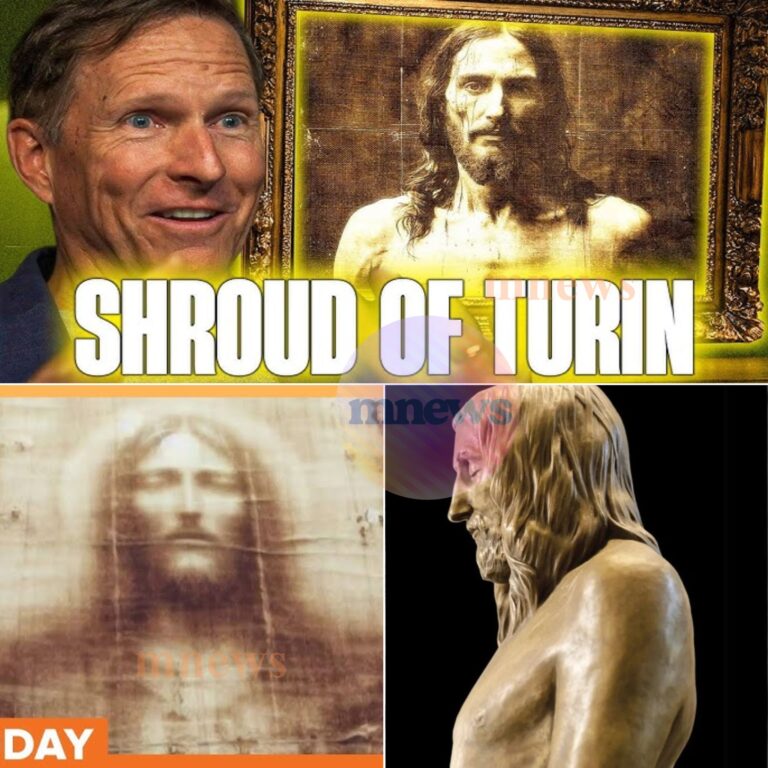
For decades, critics leaned on a 1988 radiocarbon test that dated the Shroud to the Middle Ages. Case closed—or so it seemed. But new investigations now reveal a devastating flaw: the sample tested was likely taken from a repaired corner, woven in after the Shroud was damaged by a catastrophic fire in the 16th century. If true, the dating that “debunked” the Shroud may have tested a medieval patch, not the original cloth itself.
This revelation has sent shockwaves through both scientific and religious communities. Researchers like Dr. John Campbell and Dr. Jeremiah Johnston argue that when uncontaminated sections are examined, the Shroud behaves unlike any known artwork. The image contains three-dimensional information, meaning the intensity of the imprint corresponds to body depth—something no medieval artist, using any known technique, could have produced.

Even more unsettling: no paint, dye, or pigment has ever been found forming the image. The fibers appear chemically altered at a microscopic level, as if scorched by a burst of energy. How that image was formed remains unexplained, defying physics, chemistry, and art history alike.
Those who have studied the Shroud up close describe an experience that goes beyond science. Official photographer Barry Schwarz has spoken of the overwhelming moment when the image was digitally enhanced—revealing a face that many believe carries unmistakable signs of crucifixion. For some, it wasn’t just research anymore; it felt like an encounter.

The evidence doesn’t stop there. Pollen grains embedded in the cloth trace back to plants native to first-century Jerusalem, not medieval Europe. This suggests the Shroud once existed in the very region where the crucifixion is said to have occurred, forcing historians to reconsider its documented journey through time.
Adding to the intrigue, ancient non-biblical sources—such as Roman historian Thallus—record an unexplained darkness during the time of Jesus’ execution. These accounts, long overlooked, now echo eerily alongside the Shroud’s physical evidence, forming a narrative that skeptics can no longer easily dismiss.
As new technology advances and pressure mounts for fresh testing under stricter controls, one thing is clear: the Shroud of Turin refuses to stay buried under certainty. Whether relic or riddle, it stands at the collision point of faith, science, and history.