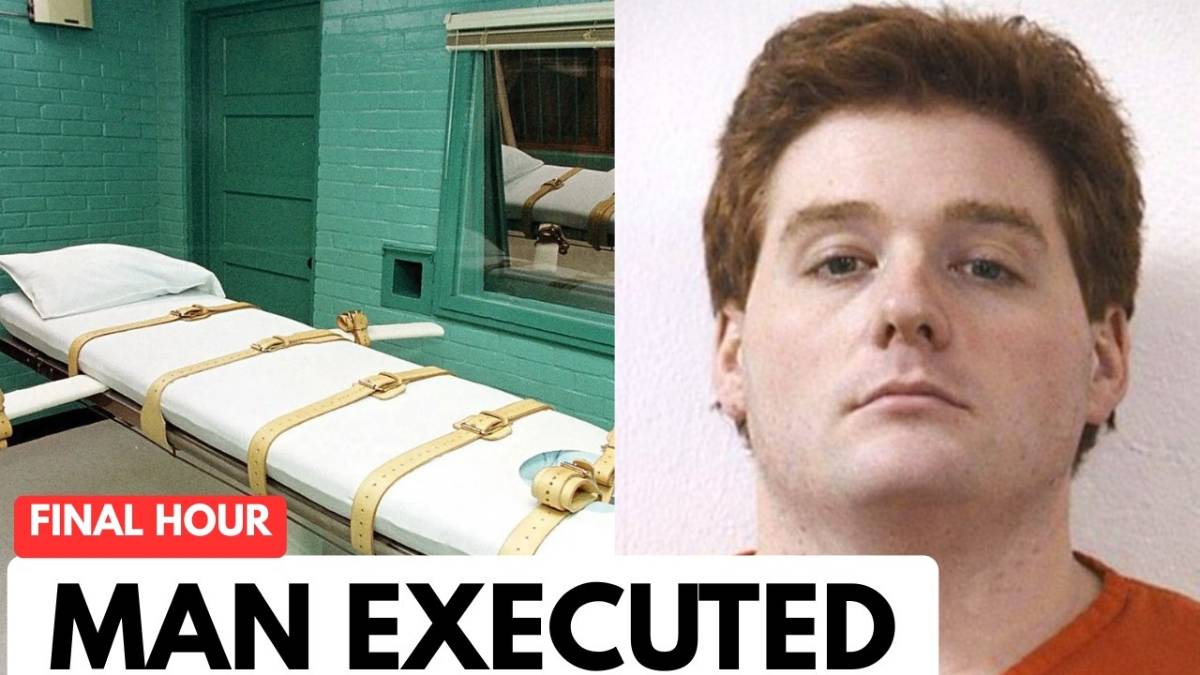
A man who confessed to the murder and intended cannibalism of his 10-year-old neighbor was executed by lethal injection in Oklahoma on Thursday, the morning of his 45th birthday. Kevin Ray Underwood was pronounced dead at 10:14 a.m. at the Oklahoma State Penitentiary in McAlester, concluding an 18-year legal saga that began with one of the state’s most horrific crimes.
 The execution proceeded after the Oklahoma Pardon and Parole Board denied clemency earlier this month. Underwood’s final appeals, which centered on arguments that his mental health conditions rendered his execution unconstitutional, were exhausted. His death marks the first execution in Oklahoma scheduled on an inmate’s birthday in recent memory.
In a brief final statement, Underwood acknowledged the date. “To schedule this on my birthday, six days before Christmas, was a needlessly cruel thing to do to my family,” he said. He then added, “But I’m very sorry for what I did, and I wish I could take it back.” Officials declared him dead minutes later.
Underwood was convicted in 2008 for the April 2006 murder of Jamie Rose Bolin. The ten-year-old girl was his neighbor in their Purcell apartment complex. Her disappearance prompted an Amber Alert and a frantic search by her father and law enforcement.
The investigation zeroed in on Underwood quickly. During a consensual search of his apartment, officers noticed a large plastic storage tub, heavily sealed with duct tape, in his bedroom closet. When questioned, Underwood’s calm demeanor shattered. “Go ahead and arrest me,” he stated. “She’s in there. Then I’m going to burn in hell.”
 Inside the tub, authorities discovered Jamie’s body. The subsequent investigation was defined by Underwood’s own detailed, videotaped confession. He did not merely admit to killing the child; he described a premeditated plan to commit an act of cannibalism.
“I wanted to know what it tasted like, and just the thought of it was appealing to me,” Underwood told FBI agents in the recorded confession. Evidence collected from his apartment supported the claim that the crime was planned in advance, not a spontaneous act of violence.
At trial, the prosecution’s case was overwhelming, anchored by the chilling confession. A McClain County jury took only 23 minutes to find him guilty of first-degree murder on February 29, 2008. One week later, the same jury recommended a sentence of death.
The legal battles that followed lasted nearly two decades. Underwood’s defense team argued persistently that his diagnosed mental illnesses—schizotypal personality disorder and, later, Asperger syndrome—diminished his culpability. They contended that executing a person with such severe mental health conditions violated the Eighth Amendment’s prohibition on cruel and unusual punishment.

Every court that heard the argument, including federal appellate courts, rejected it. The U.S. Supreme Court declined to intervene. In his final plea for clemency, Underwood offered a tearful statement to the parole board, accepting his fate while describing a disconnect from his own actions.
“I recognize that although I do not want to die, I deserve to for what I did, and if my death could change what I did, I would gladly die,” he said. The board voted 3-0 to deny mercy, clearing the final obstacle to his execution.
In his final hours, Underwood consumed a last meal of classic Oklahoma comfort food: chicken fried steak with mashed potatoes and gravy, pinto beans, hot rolls, a cheeseburger with French fries and ketchup, and a cola from the prison canteen.
 The execution was witnessed by representatives of the state, the media, and Jamie Bolin’s family. For them, the proceeding ended an 18-year wait for a conclusion they saw as justice. In a statement after the execution, Jamie’s aunt, Lorie Pate, struck a note of somber resolution.
“This doesn’t bring our Jamie back, but it does allow the space in our hearts to focus on her and allow the healing process to begin,” Pate said. The family’s grief, carried for nearly two decades, was palpable in its restraint.
Jamie Rose Bolin would have turned 29 years old this past August. Described as a bright and energetic child, her life was cut short on a spring afternoon after she accepted an invitation from a familiar neighbor to see his pet rat. Her trust was met with unimaginable brutality.
The case of Kevin Ray Underwood has long confounded those seeking a simple narrative. His defense presented a portrait of a mentally ill man, a solitary figure whose internal deterioration culminated in a single, monstrous act. Prosecutors and courts saw a predator who meticulously planned a heinous crime and confessed to it with clear detail.
For the legal system, the question of culpability was settled repeatedly over 18 years. For Jamie Bolin’s family, the profound loss of a vibrant little girl remained the central, unchangeable fact. Thursday’s execution closed the final chapter on a crime that shattered a family and haunted a community, leaving behind only the enduring memory of a victim and the complex, dark legacy of her killer.
Source: YouTube