For over a century, a concrete-sealed grave in a Philadelphia cemetery has fueled America’s most enduring true crime conspiracy: that serial killer H.H. Holmes cheated the gallows. Today, forensic science has delivered a definitive verdict.
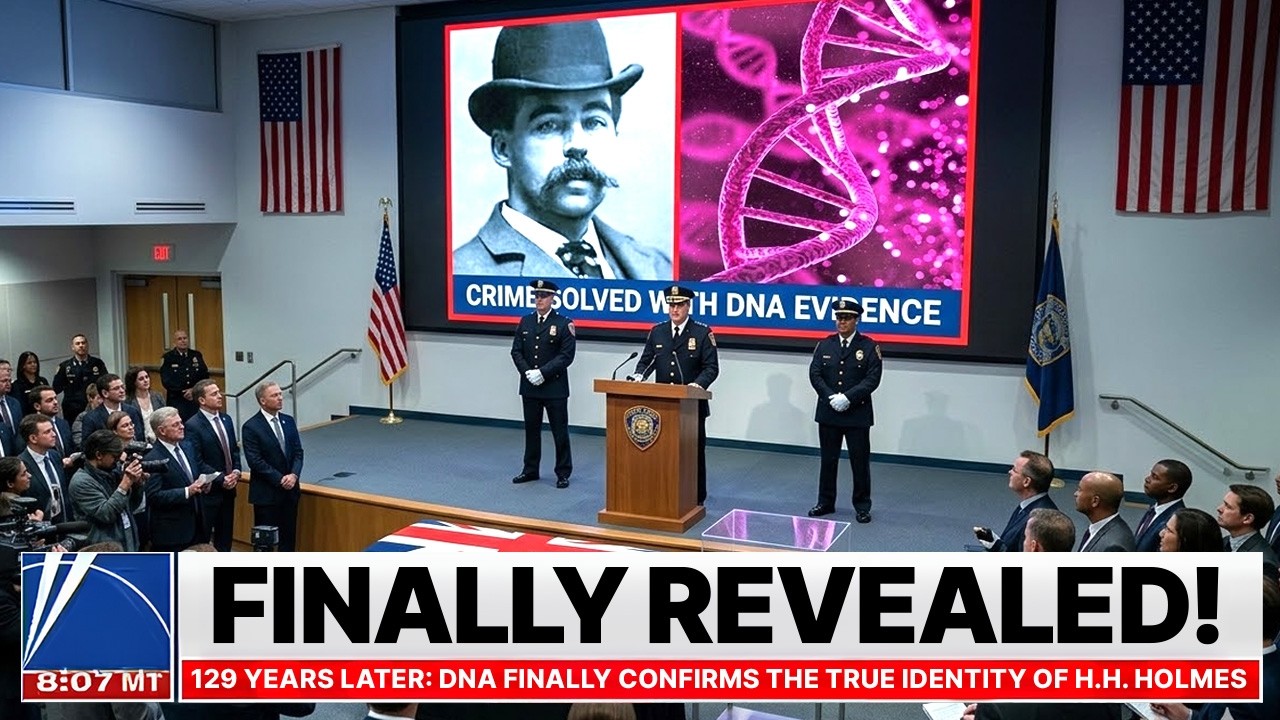
Advanced DNA analysis confirms the remains buried in that grave are indisputably those of Herman Webster Mudgett, the man known as H.H. Holmes. The findings, the result of a meticulous 2017 exhumation and a blind international DNA study, conclusively end the legend that Holmes escaped his 1896 execution.
The truth, however, unravels a narrative far more disturbing than the escape theory it disproves. The investigation exposes how a mediocre con artist was transformed into a mythical monster, and how his lies have outlived him by generations.
The exhumation at Holy Cross Cemetery nearly failed. After days of digging, archaeologists led by Samantha Cox of the University of Pennsylvania found a preserved wooden coffin—empty. It was a decoy, perfectly mirroring conspiracy theories. With time and funding exhausted, Cox ordered the team to dig deeper.
Beneath the false coffin, they struck solid concrete. After hours of brutal work breaking the 121-year-old seal, they found the real burial: skeletal remains, clothing, and a metal cross inscribed “H.H. Holmes died May 7, 1896.” The anaerobic, waterlogged tomb had liquefied soft tissue but preserved bones and teeth.
The forensic identification proceeded in three definitive stages. The skeleton matched a male in his mid-30s. Gold foil dental fillings, a mark of wealth in the 1890s, were found. Critically, a single remaining molar perfectly matched prison dental records.
The final stage sent shockwaves through the historical community. Genetic material extracted from tooth pulp was sent to King’s College London’s ancient DNA lab. Professor Denise Syndercombe Court ran the analysis blind; her team did not know the sample’s origin.
The results established a direct genetic link between the remains and Jeff Mudgett, Holmes’s living great-great-grandson. “From a scientific standpoint,” Cox stated, “there is no doubt. He didn’t fake his death. He was hanged. He died. He was buried.”

This scientific conclusion shatters the cornerstone of Holmes lore. He did not bribe guards, swap places with a lookalike, or flee to South America or London to become Jack the Ripper. The man died on the rope at Moyamensing Prison.
His death was gruesome and witnessed by dozens. Historical accounts report his neck did not break. He strangled, conscious, for fifteen agonizing minutes as officials, physicians, and priests watched in silence. He was pronounced dead thirty minutes after the trapdoor opened.
The concrete burial request, the seed of the escape myth, was a final manipulation. Holmes, who had stolen cadavers in medical school, claimed fear of body snatchers. The public interpreted it as a ruse to hide an empty grave. For 121 years, that interpretation held.
While DNA confirms who is in the grave, it reveals nothing about his crimes. This is where the real deception persists. The myth of H.H. Holmes has always been a fabrication, built not by a criminal genius, but by sensational journalism and public appetite.
Historian Adam Selzer’s research, based on original police and court records, dismantles the legend. The “Murder Castle” was not a labyrinthine killing factory. It was an unfinished, largely unfurnished building used for insurance and credit fraud.
The stories of soundproof torture chambers, acid vats, and gas chambers originated in newspapers engaged in a vicious circulation war. They were not documented in any police report. The building’s hidden rooms were likely used to hide fraudulently obtained furniture.
Holmes was a prolific bigamist and swindler, constantly sued by creditors who quickly saw through his schemes. He was bold, but not brilliant. His confirmed victim count, according to researchers who study primary documents, stands at approximately nine.
These were people he knew: his business partner Benjamin Pitezel, murdered for a $10,000 insurance payout; and three of Pitezel’s children—Howard, Nellie, and Alice—whom he suffocated. Their bodies were found in a trunk and a chimney.

His infamous confession of 27 murders was itself a con, sold for $10,000 to newspaper magnate William Randolph Hearst. It named people who were still alive. On the scaffold, Holmes recanted, admitting to only two killings.
The inflated victim count of 200 originated from a single, uncorroborated line in a 1940 pulp history book. The tale of dozens of World’s Fair visitors disappearing into his hotel is unsupported by any period missing persons reports.
The DNA evidence does not vindicate these exaggerations. It confirms only the identity of the man who perpetrated a smaller, more intimate series of murders for profit. The legend of the unprecedented super-killer is a fiction.
The 2017 exhumation ultimately performed a different autopsy. It dissected our cultural obsession with monstrous myths over complicated truths. For 129 years, the public chose a thrilling newspaper fabrication over the documented eyewitness accounts of his death.
We embraced the story of an ingenious escape artist because it was more satisfying than the reality of a petty, greedy murderer who died badly and was forgotten by all but the families he destroyed. Holmes’s greatest trick was convincing history that he was worth remembering.
His real victims—Benjamin Pitezel, his children, Julia Connor and her daughter Pearl—are footnotes in his manufactured legend. Their killers’ lies, however, escaped that concrete tomb instantly. They have grown for over a century, fed by every retelling that prioritizes spectacle over fact.
The final question is not about Holmes, but about us. If a documented liar from the 1890s can still dictate his story today, whose narratives are we accepting now, driven by the same hunger for a sensational tale? The grave is sealed. The myth, it seems, is forever open.
Source: YouTube