A groundbreaking revelation has emerged from a 46-year investigation into the Shroud of Turin, once thought to be a mere relic of medieval art. Barry Schwartz, a Jewish photographer, has uncovered compelling evidence suggesting the cloth bears the authentic image of a crucified man, raising profound questions about its origins and implications for both science and faith.
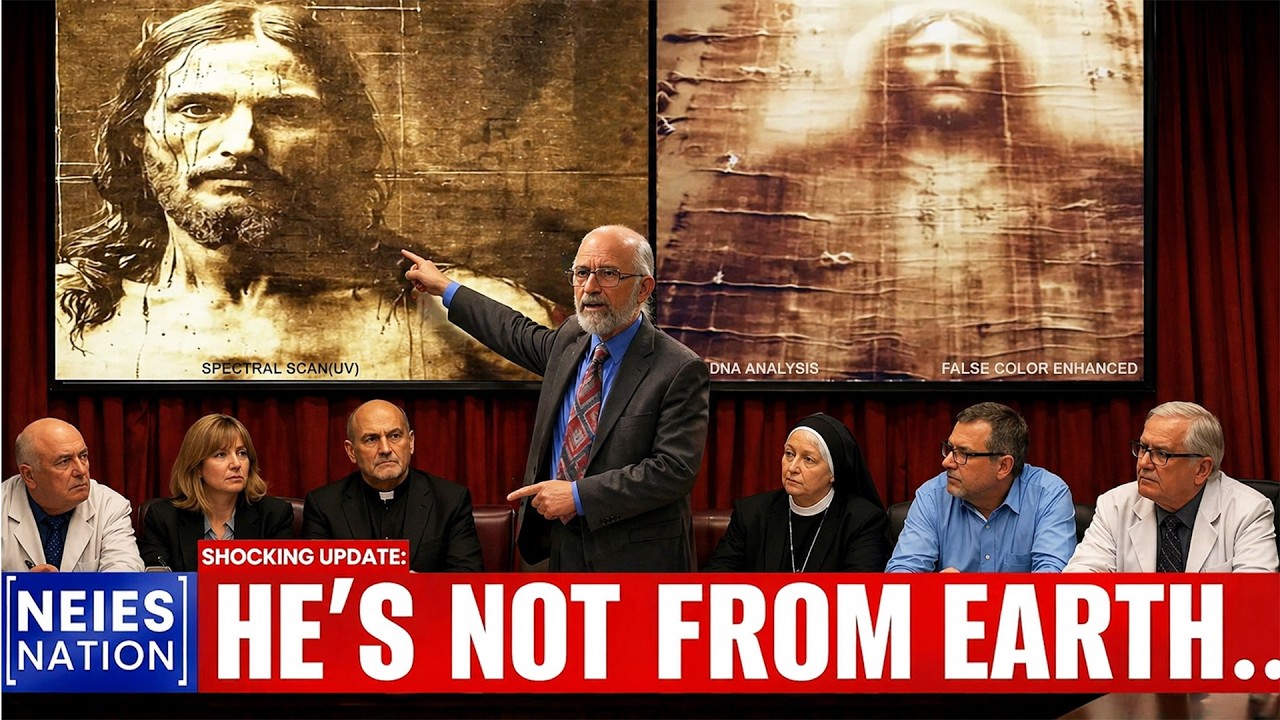
The Shroud, measuring 14 feet long, has captivated scientists and historians alike since its first photographic exposure in 1898, revealing an astonishingly detailed image that defies conventional artistic techniques. Schwartz, who initially approached the cloth with skepticism, found himself drawn into a web of scientific inquiry that would challenge his understanding of history and faith.
In 1978, Schwartz joined a team of 33 experts to analyze the cloth using cutting-edge technology. Contrary to his expectations, he discovered that the image was not created by paint, but rather displayed properties akin to a photographic negative. This revelation sparked a debate that has persisted for decades.
One of the most perplexing findings was the color of the blood stains, which remained red instead of darkening over time, a phenomenon that contradicted forensic science. This anomaly, which Schwartz grappled with for 17 years, pointed to the possibility of extreme trauma, eventually leading him to reconsider his long-held doubts.
The investigation took a pivotal turn when a dying blood chemist revealed that the blood contained high levels of bilirubin, a compound released under extreme stress. This finding explained the unusual coloration, suggesting that the cloth could indeed be linked to a real historical figure, potentially Jesus of Nazareth.
Further studies have shown that the blood type found on the Shroud matches that of the Sudarium of Oviedo, a cloth with a documented history dating back to the 6th century. This correlation raises significant questions about the authenticity of the Shroud and its connection to early Christian history.
Despite the compelling evidence, the Shroud’s origin remains shrouded in controversy. In 1988, radiocarbon dating placed its creation in the medieval period, a conclusion that many researchers now dispute due to concerns regarding sample contamination and the testing process itself.
New techniques, including wide-angle X-ray scattering, suggest that the cloth may date back to the first century, aligning with historical accounts of its movement across regions. The ongoing debate highlights the complexity of the Shroud’s narrative, intertwining science, history, and faith in a way that continues to captivate the world.
As the investigation evolves, the Shroud of Turin remains preserved in Turin, Italy, a silent witness to centuries of inquiry and debate. The cloth stands as a testament to the intersection of art, science, and spirituality, inviting further exploration and discussion that is far from over.