**Scientists Sequenced Ötzi the Iceman’s DNA Ancestry — And What Was Found Shocked the Entire World!**
Over five thousand years ago, a man was frozen in the Alps, his body perfectly preserved in ice. When scientists sequenced Ötzi the Iceman’s DNA, they uncovered unexpected secrets that could hold the key to a hidden past. Join us as we explore the astonishing findings that shocked the world!
The Frozen Mystery of Ötzi the Iceman
On a crisp September day in 1991, what began as a peaceful hike turned into one of the most significant archaeological discoveries. Experienced hikers Erika and Helmut Simon were traversing the Ötztal Alps, located on the border of Austria and Italy, when they stumbled upon something extraordinary.
Partly buried in melting ice, they discovered a human body. Initially, they thought it might be a recent victim of the mountains, but as they got closer, it became clear that this was something much older.
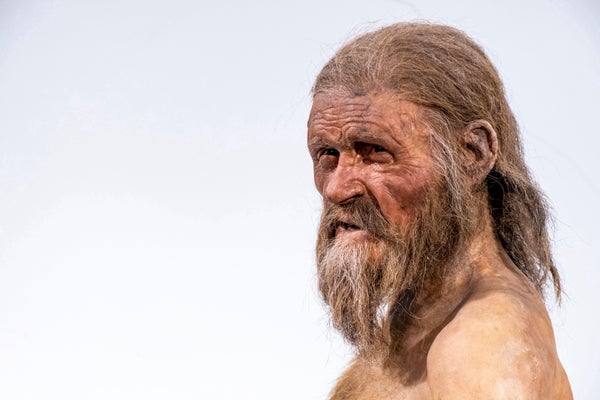
The man, later named Ötzi, was found wearing thick leather shoes stuffed with grass for insulation and clutching a copper axe, a rare and valuable tool for his time. His body was remarkably well-preserved, with features still recognizable after millennia. Carbon dating revealed that he lived around 3300 B.C.E., during the Copper Age, providing a glimpse into an ancient world.
Ötzi’s remains offered insights into daily life during his time, revealing not only his clothing and tools but also the circumstances surrounding his death. Forensic analysis showed that he was about 45 years old at the time of his death, a significant age for that era. His body indicated a life of hard work and survival in a challenging environment, standing approximately five feet three inches tall and weighing around 110 pounds.
The Shocking Details of His Death
Among the most intriguing aspects of Ötzi were his 61 tattoos, strategically placed on his body, likely for therapeutic purposes, possibly akin to acupuncture. These markings suggested that he was trying to alleviate pain from arthritis, highlighting that even in ancient times, people sought relief from ailments.
However, the circumstances of Ötzi’s death were far from peaceful. Forensic studies revealed that he had not died from natural causes but had been violently attacked. He bore a deep wound on his hand, indicating a struggle, and most notably, an arrowhead was found lodged in his left shoulder, suggesting he had bled to death from a fatal injury. Additionally, blood from four other individuals was detected on his clothing, hinting at a violent confrontation.
Ötzi’s DNA Mystery — How Science Got It Wrong
In the years following Ötzi’s discovery, researchers became increasingly fascinated with his well-preserved remains. In 2012, scientists managed to extract and map a rough version of Ötzi’s genome, revealing that he had light skin and brown eyes. Most notably, they found traces of “steppe ancestry,” suggesting connections to later migrating Indo-European peoples, which challenged established timelines.
However, doubts about contamination arose, leading to a more rigorous examination of his DNA. In 2023, scientists from the Max Planck Institute conducted a new analysis, extracting DNA from a fragment of Ötzi’s hip bone. This time, the results contradicted previous findings; the supposed steppe ancestry was absent. Instead, Ötzi’s DNA showed that he was primarily descended from Neolithic Anatolian farmers, with no direct connection to later migrations.

The Forgotten Clues in His Skin
While the DNA analysis was groundbreaking, another significant discovery emerged from Ötzi’s skin. His tattoos, initially thought to be random markings, were found to correspond with acupuncture points, suggesting an early form of medical treatment. This revelation indicated that Ötzi was not just a solitary figure but part of a network that valued health knowledge.
The Roots of Ötzi — The Story We Never Expected
Ötzi’s ancestry tells a story of isolation. His genetic makeup indicated that he belonged to a small, isolated community, which had remained separate from the migrations that reshaped Europe. This isolation meant that his lineage had nearly vanished, surviving only in a few places, such as Sardinia, where descendants of his ancestors still live.
In summary, Ötzi the Iceman is not just a relic of the past; he represents the complexities of human life, including struggles with health, survival, and the impact of isolation on genetic diversity. His story serves as a reminder that our understanding of history is continually evolving, shaped by new discoveries and insights.