In a historic realignment of transatlantic defense, Canada has been granted exclusive access to the European Union’s flagship €150 billion military procurement program, deliberately sidelining the United States. The landmark agreement, finalized on December 1st, marks the first time a non-EU nation has been invited into the EU’s Security Action for Europe (SAFE) initiative, a decisive geopolitical shift that permanently alters North America’s influence in Europe.
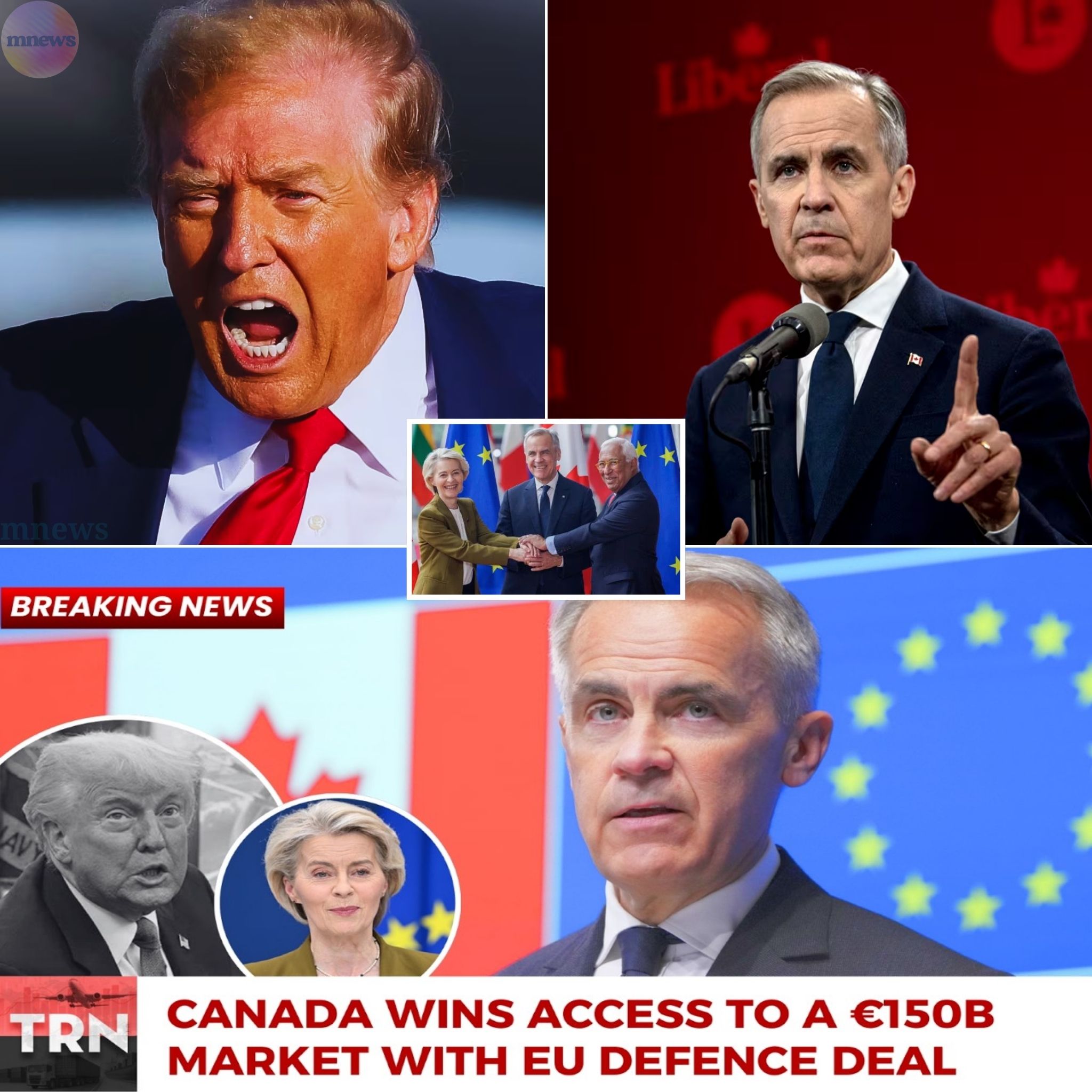
Prime Minister Mark Carney announced the conclusion of fast-track negotiations, securing Canadian companies’ full participation in Europe’s next-generation defense competitions. This provides direct access to a market encompassing ammunition, artillery, drones, missile components, and advanced electronics over the next decade. Officials stated the deal is a direct response to economic and political changes originating south of the border.
The arrangement is a stark rebuke to the United Kingdom, which failed to finalize its own SAFE participation over access fees, and a conscious exclusion of the United States. European officials, according to Reuters and AP reporting, are prioritizing predictable, rules-based partners as the bloc works to reduce dependence on American defense systems and rebuild its own industrial capacity.
For Canada, this represents a fundamental strategic pivot. Decades of deep integration with the U.S. defense industrial base have given way to a deliberate diversification strategy. Canadian officials openly framed SAFE as part of a plan to adapt to the “new normal” of volatile U.S. trade policy and political uncertainty under President Donald Trump.
The economic implications are colossal. SAFE is designed to channel over €150 billion into European defense manufacturing and technology. Canadian firms are now positioned to compete for these funds without being overshadowed by American defense giants, catalyzing what officials predict will be massive private investment in Canadian research and production facilities.
Politically, the move signals Canada’s declining reliance on Washington. By gaining a “second anchor” in Europe, Canada insulates its defense sector from U.S. tariff threats and policy swings. It also grants Ottawa newfound leverage in any future negotiations with the United States, as it no longer depends solely on the U.S. market.
The exclusion of the U.S. underscores a growing transatlantic divide. The EU’s decision reflects a loss of confidence in American predictability and a determined push for strategic autonomy. Canada’s reputation for political stability and reliable partnership proved to be a decisive asset where the U.K.’s proximity and the U.S.’s dominance were liabilities.
This breakthrough is the centerpiece of a broader Canadian foreign policy overhaul under Prime Minister Carney. Throughout 2025, Ottawa has aggressively pursued new defense partnerships with South Korea, increased funding for the European Space Agency, and opened Indo-Pacific military cooperation, constructing a multi-continental web of alliances.
The deal arrives amid escalating trade hostilities with the Trump administration. Fresh U.S. tariffs on Canadian goods, including a recent 10% levy imposed days before the Asia-Pacific Economic Cooperation summit, have failed to force concessions. Instead, they have accelerated Canada’s global outreach.
At the APEC summit in Busan, President Trump publicly refused to meet with Prime Minister Carney. Undeterred, Carney proceeded to confirm a meeting with Chinese President Xi Jinping and announced ambitious plans to increase Canada’s non-U.S. exports by 50% within a decade, targeting markets in Malaysia, Indonesia, and the Philippines.
The Canadian government has also drawn a firm red line on domestic policy, refusing to negotiate its supply-managed dairy sector despite intense U.S. pressure. Parliament passed legislation this summer explicitly shielding the system from trade talks, unifying the country against what is seen as American economic coercion.
Meanwhile, the fallout from U.S. protectionism is rippling through American agriculture. China, the former largest buyer of U.S. soybeans, has purchased zero new-crop American beans this season, instead turning to Argentina and Brazil. As U.S. silos fill with unsold produce, Canada has inked a new trade deal with Indonesia, a major soybean importer, further displacing American market share.
From the Arctic to Asia, Canada is executing a coherent strategy of sovereign independence. In Nunavut, federal funding is advancing the Aalowit Hydro Project, a clean-energy initiative designed to replace diesel dependence and assert Canadian infrastructure leadership in the contested North. This nation-building investment stands in direct contrast to Trump-era cuts in U.S. Arctic research and renewable energy.
Analysts see a definitive turning point. Canada is no longer waiting for the United States to set the agenda. By securing a prime position in Europe’s defense future, locking down Asian trade alternatives, and fortifying its Arctic sovereignty, Ottawa is demonstrating that it can and will operate beyond Washington’s shadow. The message to allies and adversaries alike is clear: Canada is building its own future.