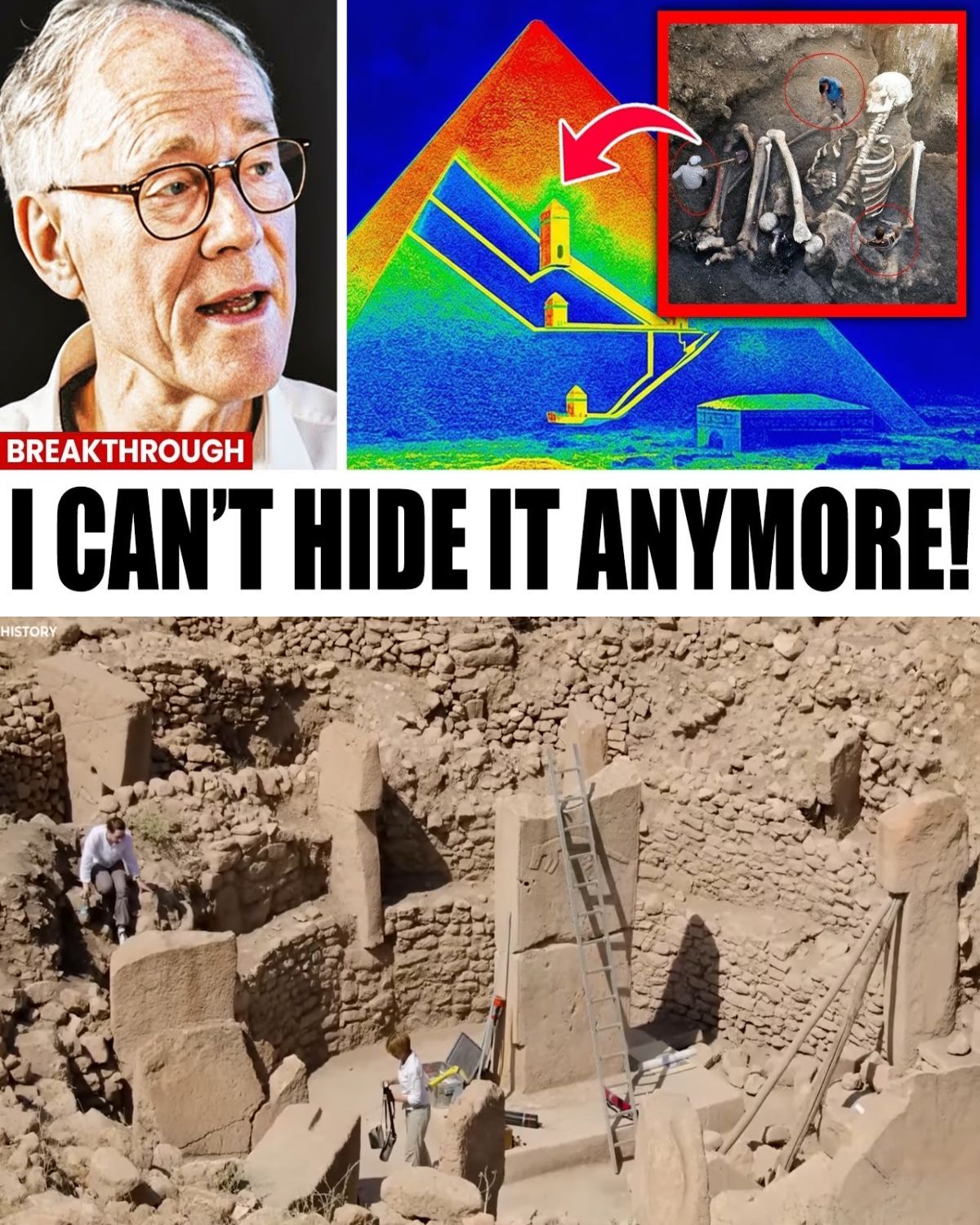
In a stunning revelation that could redefine our understanding of ancient civilization, renowned researcher Graham Hancock claims to have uncovered evidence suggesting the Great Pyramids of Giza were not built by the ancient Egyptians as previously believed. Reporting from the Giza Plateau, Hancock presented a compelling case that points to a long-lost civilization possessing advanced knowledge of architecture, astronomy, and engineering.
 Hancock’s investigation centers on the astonishing precision of the pyramids, constructed from over 2.3 million stone blocks, some weighing up to 80 tons. Despite the monumental scale of the project, no credible evidence exists to explain how these blocks were transported and perfectly aligned. The precision of the pyramid’s foundation, spanning 13 acres and remaining level to within an inch, raises further questions about the techniques employed by the builders.
Recent discoveries, including a hidden chamber within the Great Pyramid, have only deepened the mystery. Discovered in 2017 through advanced scanning technology, this 30-meter-long void lies sealed, with no known entrance. Hancock believes its existence hints at a purpose beyond mere burial, potentially safeguarding knowledge from a civilization that faced impending catastrophe.
 The alignment of the pyramids with celestial bodies adds another layer to Hancock’s argument. He asserts that the internal shafts of the King’s Chamber align with the stars of Orion and Sirius, suggesting that the builders possessed an intricate understanding of astronomy that far predates the accepted timeline of Egyptian history. This astronomical knowledge, Hancock argues, indicates a connection to a sophisticated culture that existed thousands of years before the pharaohs.
Geological evidence also supports Hancock’s claims. Research by geologist Dr. Robert Shock revealed that the Sphinx and its surrounding structures exhibit signs of erosion consistent with heavy rainfall, a climatic condition that has not occurred in Egypt for thousands of years. This suggests that these monuments may trace back to an era long before the ancient Egyptians.
 Hancock’s theories extend beyond the pyramids themselves, linking them to ancient sites worldwide. He posits that monuments in Mexico, Cambodia, and even England reflect similar celestial alignments, hinting at a network of knowledge shared among a lost civilization. The implications of such a connection challenge the very foundations of our historical understanding.
 The Younger Dryas impact hypothesis, which posits that a cosmic event caused a catastrophic climate shift around 12,800 years ago, further supports Hancock’s narrative. He believes that survivors of this disaster preserved their advanced knowledge, which eventually influenced the civilizations that followed, including the Egyptians.
As Hancock continues to unravel the mysteries of the Giza Plateau, he insists that the pyramids were not merely tombs for pharaohs but monumental beacons of knowledge meant to endure through the ages. The hidden chamber, with its precise construction and isolation, could serve as a vault for this lost wisdom, waiting to be rediscovered.
The world watches as Hancock’s findings challenge established narratives and invite a reevaluation of humanity’s ancient past. Could the pyramids be the remnants of a forgotten civilization that understood the cosmos in ways we are only beginning to comprehend? The quest for answers continues, igniting a fire of curiosity and debate that may reshape our historical timeline forever.